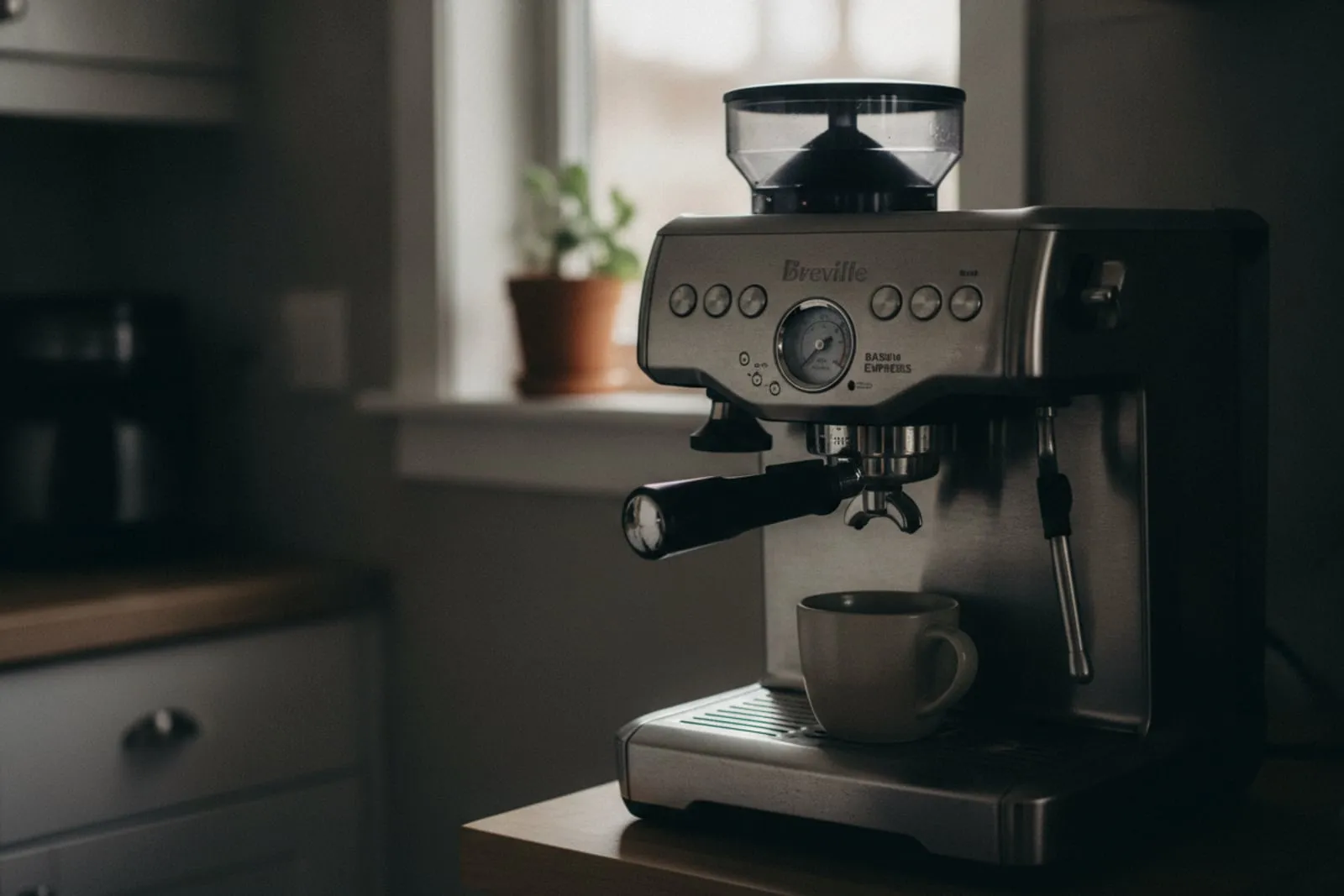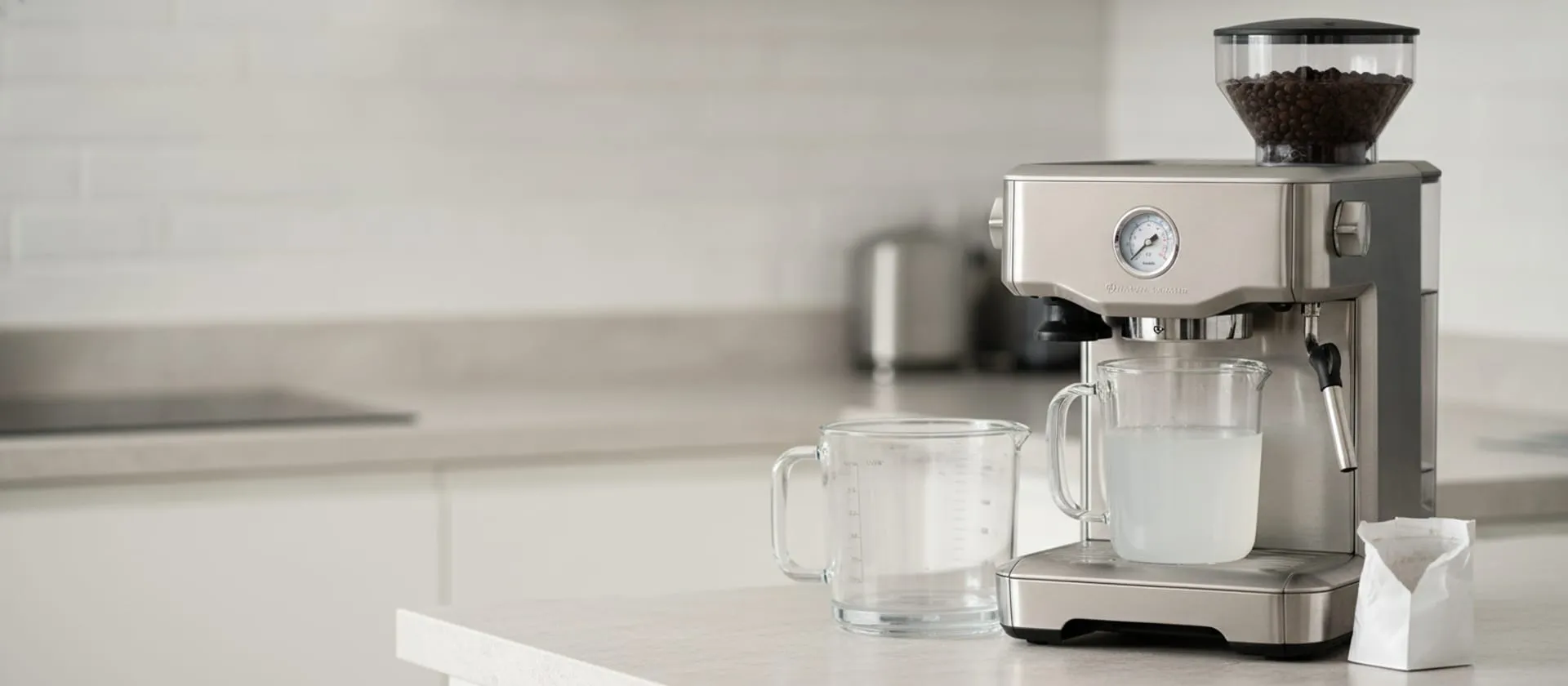
How to Descale a Breville Espresso Machine
How to descale a Breville Barista Express or Barista Pro, step by step from Breville's own instruction books, and what a descale cannot fix on these machines.
A Breville tells you when it wants a descale, and on the two machines we see most it tells you differently. The Barista Express has one light that means two things. The Barista Pro puts a word on the screen. Read the signal wrong and you run the wrong cycle, the light stays on, and the machine keeps scaling up while you think it is clean.
This guide follows Breville’s own instruction books for the Barista Express (BES870) and the Barista Pro (BES878), step for step, and then covers the part the books leave out: what a descale does not fix.
First, read the light correctly
On the Barista Express the CLEAN / DESCALE light does double duty:
- Flashing means a cleaning cycle. That is a back-flush with a cleaning tablet in the 1 CUP basket behind the cleaning disc, started by holding 1 CUP, 2 CUP and POWER together for about ten seconds with the machine off. It runs about five minutes.
- Solid on means descale. Different solution, different buttons, described below.
On the Barista Pro the LCD shows a DESCALE alert. There is no shared light to misread, which is the main reason Pro owners get this right more often.
Both cycles matter, and they clean different things. The back-flush clears coffee oil out of the group and the solenoid path. The descale dissolves mineral deposit in the water path: the thermocoil, the pump outlet, the steam and hot water lines.
What you need before you start
- Breville descaling powder or another descaler made for espresso machines. One sachet goes into one litre of water on the Express; on the Pro you fill the tank to its DESCALE line and add the agent.
- A container of at least two litres that fits under the group head and the steam wand together. A large glass measuring jug works. Mugs do not; you will be chasing overflow.
- An empty drip tray.
- About thirty minutes in which nobody needs coffee.
Take the water filter out of the tank first. Breville’s Barista Pro book says so in a note at the top of the descale section, and the same logic applies to the Express: a filter cartridge sitting in descaler is a cartridge you have just ruined.
Descaling a Barista Express (BES870)
Breville’s sequence, in plain words:
- Confirm the CLEAN / DESCALE light is solid, not flashing.
- Dissolve one sachet in one litre of water and pour it into the tank. Breville warns that the tank should never be removed or completely emptied during descaling, so put it back and leave it there.
- Starting with the machine off, press and hold 2 CUP, then press and hold POWER as well. The POWER button flashes while the machine heats. It is ready when POWER, 1 CUP, CLEAN / DESCALE and HOT WATER / STEAM are all lit and steady.
- Press 1 CUP. The coffee side descales for about 25 seconds; pressing 1 CUP again stops it early.
- Turn the steam dial right, toward steam. About 13 seconds.
- Turn the dial left, toward hot water. About 8 seconds. Return the dial to standby.
- Roughly half the solution is still in the tank. Repeat steps 4 to 6 until it is used up.
- Take the tank out, rinse it, fill it with fresh cold water to the two-litre maximum, put it back, and run steps 4 to 6 again to flush the solution out.
- Press POWER to leave descale mode. The lights go out.
The one trap: if you leave the machine for five minutes without pressing anything, it switches itself off and you start again from step 3. That timeout is the usual reason a descale “did not take” and the light comes back.
Descaling a Barista Pro (BES878)
The Pro runs the cycle for you and only asks you to turn the dial:
- Empty the drip tray. Take the tank out and remove the water filter.
- Fill the tank to the DESCALE line, add the descaling agent, refit the tank.
- Press MENU, turn the GRIND AMOUNT dial to DESCALE, press the dial to select it. The 1 CUP button lights up.
- Press 1 CUP. The machine descales in three stages: coffee, hot water and steam. It beeps after each one, and the screen tells you when to turn the steam dial to hot water and to steam.
- When the descale stage ends, the 1 CUP button lights again for the rinse. Empty the drip tray, pour out what is left in the tank, fill it to MAX with fresh water and refit it.
- Press 1 CUP for the rinse, which is also three stages with the same dial prompts.
- The machine beeps and returns to READY. Rinse and dry the tank and the drip tray.
Barista Touch, Oracle and Dual Boiler
The Barista Touch and the Oracle Touch run their descale from the touchscreen menu, and the screen walks you through the dial turns the same way the Pro does.
The Dual Boiler and the older Oracle are a different job. They have two boilers, and their descale involves draining them through valves behind a cover on the front of the machine. Follow the instruction book for your exact model number, which is on the machine’s rating label, and do not improvise from a video made for a single-boiler machine. A drain valve left half closed is the most common reason one of these leaks onto the counter after a home descale.
How often, on Los Angeles water
Run the cycle when the machine asks for it rather than on a calendar. What moves the interval is hardness, and LA hardness depends on the neighbourhood: LADWP blends aqueduct, Colorado River and groundwater sources in different proportions across the city, so two addresses a few miles apart can scale at very different rates. The annual water quality report has the range for your area.
The cheapest thing you can do is the one in the book: change the tank filter every two months. Breville says plainly that a fresh filter reduces the need to descale, and in a hard water area it recommends changing it more often.
What a descale will not fix
A descale reaches the water path. If the machine still misbehaves after a full cycle and a rinse, the cause was somewhere the solution never went:
- Shots still slow or choking. Usually the grind or the dose, or a group gasket that has gone hard and lets the puck sit wrong. Not scale.
- Water dripping from the group after the shot, or a wet puck. The solenoid valve, which takes coffee oil, not mineral. The back-flush helps; a stuck valve needs to come out.
- Pump loud, little or no flow. Sometimes loosened scale that moved downstream and lodged in something narrower. That needs the machine opened.
- Steam weak on a single-boiler machine. Often the steam tip. Unscrew it and clear the holes with the pin from the cleaning kit before you blame the thermocoil.
The longer list, in the order to check it, is in our guide on what to do when descaling didn’t fix it. If you want to see where each of these parts sits inside an Express, the Barista Express parts diagram shows the machine opened up.
When it is a bench job
Our flat-rate Breville service is $249. It includes the full descale of the thermocoil or boilers and the steam path, plus the parts a home descale never touches: a new group gasket and shower screen, the solenoid valve pulled and cleared, the grinder stripped and re-indexed. A courier collects the machine and brings it back.
If something has actually failed, the work starts with a diagnostic instead. The $145 diagnostic is credited in full toward the repair when you approve the estimate. The Breville page lists the faults we see on each model, the maintenance page has every flat rate side by side, and if the machine is out of warranty and you are weighing the cost, read the out-of-warranty guide first. Pickups start in Los Angeles and run across the whole service area.