Coffee grinder repair. Burrs, zero, calibration.
Mahlkönig, Mazzer, Eureka, Ditting and every other grinder that costs a thousand dollars or more. Collected by courier across Los Angeles, Orange County, San Diego, the Inland Empire and Ventura, or serviced where it stands.
California Bureau of Household Goods and Services Reg. #A49573 · Insured
A grinder has one job and three ways to do it badly: blunt burrs, burrs that do not sit square, and a dose it can no longer measure. None of them stops the grinder. It keeps running and the coffee gets worse a little every week, which is why grinders are serviced last and blamed last.
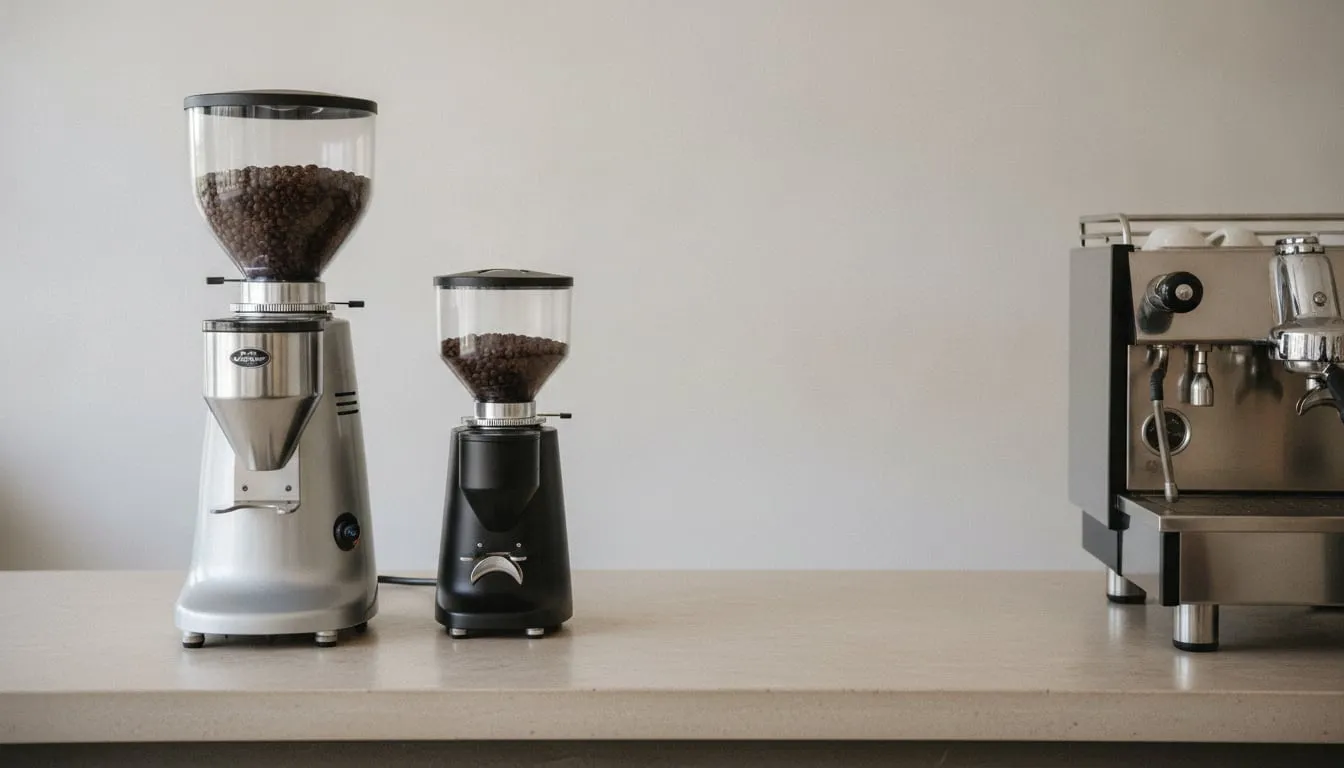
What a grinder service
actually is.
Burrs
Pulled, cleaned and measured. Whether they are replaced is arithmetic: the maker’s figure in kilograms against the coffee that has gone through. Mazzer gives 400 kg for a Super Jolly. Mahlkönig gives about 6,000 kg for an EK43. One rule for both is wrong for both.
Zero and alignment
The burr seat is cleaned to bare metal, the screws are tightened evenly, and the point where the burrs touch is found again. After that the dial means something. A grinder with new burrs and an old zero is a grinder nobody can dial in.
Calibration
A timed grinder is set to a reference dose. A grind-by-weight grinder has a scale in the fork, and the scale is calibrated with a reference weight. Then the grinder is set on your coffee, which is why we ask for a bag of it.
Four makers
with a page each.
Each page has the models, the burr sets with their rated life, and the faults the maker’s own manual lists.
- Mahlkönig grinder repair EK43, EK Omnia, E65 and E80, Guatemala. Burr sets rated from about 800 kg to 6,000 kg, and a scale inside the grind-by-weight models.
- Mazzer grinder repair Super Jolly, Major, Kony, Robur, Kold and ZM, and the old doser models. Burr life from 400 kg on a Super Jolly to 1,200 kg on a Major VP.
- Eureka grinder repair Atom W, Atom Excellence, Helios, Olympus, Oro Zeus, and the Mignon range under them. Adjusted from the lower burr, so the setting survives a cleaning.
- Ditting grinder repair 807, 807 Lab Sweet, 1203 and 1403 shop grinders. Burrs rated in tons. What wears is the bag end.
Grinders on a brand page we already had
- Fiorenzato grinders F64 EVO and F64 EVO PRO, F83 E and F83 E PRO, the PRO Sense grind-by-weight models, AllGround. New from $1,125 to $3,095.
- Victoria Arduino grinders My Mythos 75 and 85, the gravimetric MYG75 and MYG85, MYONE and Mythos GX. New from $4,400 to $6,250.
- Nuova Simonelli grinders Mythos Basic and Mythos Plus, 75 mm burrs. New from $3,250 to $3,750.
- La Marzocco grinders Swan, an 83 mm conical at $4,700, the Lux D built by Mazzer, and the Pico.
- Bunn grinders G1, G2 and G3 HD bulk grinders, GVH and the multi-hopper MHG. New from $1,457 to $1,983.
No page of its own,
serviced all the same.
- Compak. E8 OD, Bolt 83, PK100 and R120, with 83 to 120 mm flat burrs. New from $2,379 to $5,517. No US office: parts and warranty run through the dealer who sold it.
- Ceado. E37S, E37SD, E37J, E37T, E37Z-Hero and the Rev range, 64 and 83 mm burrs. New from $1,099 to $5,500. Dealer-supported in the US.
- Anfim. Luna, 65 mm at $1,399, and Alba, 80 mm at $1,999. A Hemro brand, so its parts come from the same Seattle store as Mahlkönig and Ditting.
- Weber Workshops. EG-1 with 80 mm flat burrs at $4,000 to $4,500, the Key with an 83 mm conical at $2,050, and the HG-2 hand grinder. Parts come direct from the maker.
- Kafatek. Monolith Flat MAX with 98 mm burrs at $3,600, the 80 mm Flat SDRM and the 71 mm Conical. Built in batches and supported by the maker.
- Option-O. Lagom 01 with 102 mm burrs at $2,650, and the P80 at $1,595. An Australian maker with no US service address.
- Acaia and Zerno. Acaia Orbit, 64 mm, from $1,450. Zerno Z1 and Z2, built in Chicago, from $1,315 and $2,099.
Prices are the sellers’ list prices for a new grinder in October 2026. They are here to show which grinders this page is about. A Baratza, a Niche, a Eureka Mignon or a Breville is under the line and is taken at the same service price.
Eight faults,
one of them is just dirt.
- Burrs past their kilograms. The first sign is time: the same dose takes longer, and the barista goes finer every week to hold the shot. Every maker publishes a figure, and they run from 400 kg on a 64 mm set to several tons on a shop grinder.
- Humming, not grinding. A stone or a screw between the burrs, or a grind taken finer with the motor stopped and coffee in the chamber. Switch it off. A stalled motor heats quickly.
- Motor running, nothing at the chute. The outlet is packed with fines. It happens at fine espresso settings and it builds for weeks before it blocks.
- Zero point lost. The number on the dial or the display no longer matches the gap between the burrs. It follows every burr change that was not finished properly.
- Weighing wrong. A grind-by-weight grinder has a load cell in its fork. It drifts, it dislikes an unsteady counter, and on some models it is damaged by carrying the grinder by the fork.
- Will not start, or starts slowly. Start capacitor, switch or contactor. Tested with a meter. On a few models the cause is a hopper safety switch that is not being pressed.
- Trips out when busy. Thermal protection. Every grinder has a rated duty cycle, and some are short. One trip in a rush is the grinder protecting itself. Trips on a quiet morning are a fault.
- Bag clamp, knocker, doser. On shop grinders and old doser models the hardware a person touches wears before anything inside does.
The burr question has a guide of its own: when grinder burrs need replacing, and who should do it.
By courier,
or on your own counter.
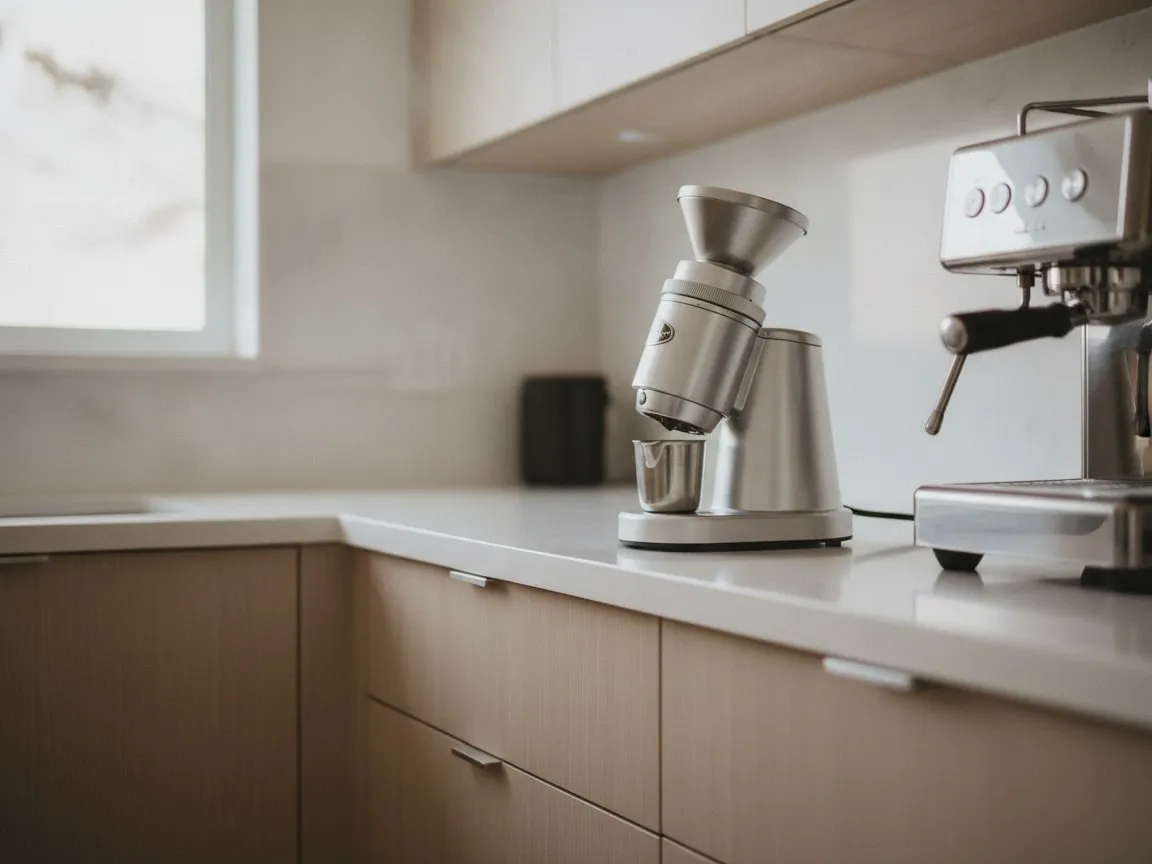
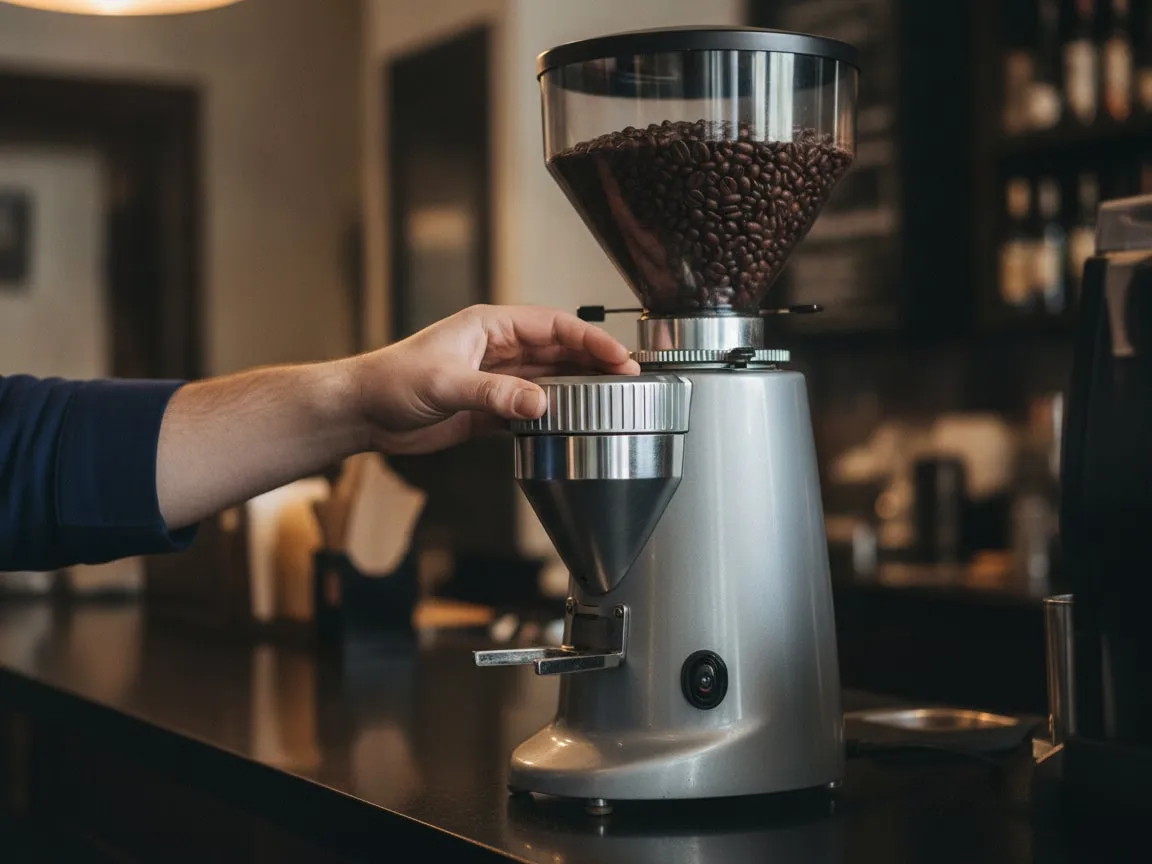
A grinder on its own travels. A courier collects it from your address and brings it back, and you box nothing. Empty the hopper, note the grind setting it was on, and send a bag of the coffee you use. The route is the same one our collected machines take.
On the bench a doserless espresso grinder is about an hour of work, and closer to two when the burrs are changed and the zero is set again. A shop grinder takes longer because of the bag end. The days either side are transport.
If we are already at your bar for the espresso machine, the grinder is done there, at the add-on price. That is the cheaper way to have it serviced, and it is why a maintenance contract should name the grinders as well as the machine.
A grinder can also be serviced where it stands, with no machine involved. That is the route for a bar with one grinder, and the only route for the ones that do not travel: a three-phase Ditting 1403, or an 1827 at 240 kg. A technician comes out, starts with the diagnostic and writes the estimate before the work begins.
One flat figure,
parts on top only if needed.
- Burrs pulled, measured against the wear spec, cleaned and re-seated — or quoted for replacement if they are past it.
- Chute, doser and exit path cleared of packed fines and coffee oil.
- Hopper and collar degreased.
- Adjustment collar and stepless mechanism cleaned so the setting holds.
- Grind re-set to a reference dose and time on your beans, output weight and consistency checked at three settings, burr wear measured and reported.
If something is wrong
$145 diagnostic — includes pickup from your address and return delivery. It is credited in full toward the repair when you approve the estimate.
If we come to the grinder: $145 diagnostic — a technician comes to you. It is credited in full toward the repair when you approve the estimate. The flat figure above is the bench price and the add-on price. Work done on a visit for a grinder alone is quoted in writing after the diagnostic.
Typical repair figures: burr replacement on a 64 to 83 mm flat set $180-$320. Strip and clear of a packed chamber and chute $150-$230. Zero and grind reference after a burr change $150-$225. A 98 mm set, an 80 mm set or a conical costs more as a part than those ranges allow for, so those burr changes are quoted with the part named. What the repair costs depends on what we find. You get a written estimate before anything is done, and you can decline it — we bring the machine back and nothing further is owed.
Typical call, the way it usually goes: an 83 mm espresso grinder on a cafe bar, shots running long, the collar turned finer for two months. The outlet is found packed and the burrs are well past the maker’s figure. New burrs on a cleaned seat, thread oiled, zero found, set on the cafe’s own coffee. About 90 minutes on the bench.
Every other price we charge is on the pricing page, and the full scope of each service is on the maintenance page.
The 800-pound rule
is one grinder’s number.
You will read that burrs are finished after 800 to 1,000 pounds of coffee. That figure is Mazzer’s 400 kg for a Super Jolly, converted to pounds and repeated as if it covered every grinder. It is right for a 64 mm set. A Major VP is rated for three times that. A Mahlkönig EK43 set is rated for about 6,000 kg and costs $599.99 from Mahlkönig USA, so replacing it on the 800-pound rule throws away more than nine tenths of it.
The opposite mistake costs more. A cafe that runs a Super Jolly at 10 kg a week reaches 400 kg in nine months. If that set is still in the grinder two years later, it has done more than twice its rated life. Weigh what you grind. Then look up your own burr set.
Where the courier
goes.
Collection and visits cover the five counties we work in. The grinder pages are paired with the areas they are most often asked about: Downtown LA, Silver Lake, Hollywood, Pasadena, Long Beach, Orange County, San Diego, the Inland Empire and Ventura. A roastery with a shop grinder and a cafe with two espresso grinders are the same route and the same price.
Frequently asked.
Q-01 What does coffee grinder repair cost?
Q-02 Which grinders do you repair?
Q-03 Do you come to the cafe, or does the grinder leave?
Q-04 How do I know the burrs are worn and not just dirty?
Q-05 Can I replace the burrs myself?
Q-06 Are you an authorized service center for any grinder maker?
Q-07 Do you repair Baratza and Breville grinders?
- R-01 Mahlkönig USA — burr sets, part numbers and rated grind life Accessed October 2026
- R-02 Mazzer — burr codes and indicative service life Accessed October 2026
- R-03 Eureka — Atom W 75 specifications and burr lifespan Accessed October 2026
- R-04 Ditting — current grinder range Accessed October 2026
- R-05 Voltage Coffee Supply — Victoria Arduino and Nuova Simonelli Mythos, Fiorenzato, Compak, Bunn list prices Accessed October 2026
- R-06 Whole Latte Love — Ceado grinders, list prices Accessed October 2026
- R-07 Weber Workshops — EG-1 and replacement service parts Accessed October 2026
- R-08 Baratza — repair programme and parts Accessed October 2026
- R-09 California Bureau of Household Goods and Services — licence lookup Accessed October 2026
Every figure on this page is ours to stand behind — who we are and what we're licensed for.
Send the grinder.
And a bag of beans.
Tell us the maker, the model and what the coffee is doing. If you know how many kilograms a week go through it, tell us that too.
Emergency · 24/7
25 cities · same-day