01
The burr seat is cleaned first
New burrs on a dirty carrier sit crooked, and no setting on the collar fixes that. The seat goes back to bare metal before a burr is screwed down.
Mazzer Super Jolly, Major, Kony, Robur, Kold and ZM grinders, old doser models included. Picked up by courier in Hollywood, Long Beach and San Diego, and sent back with the burr seat cleaned and the collar turning freely.
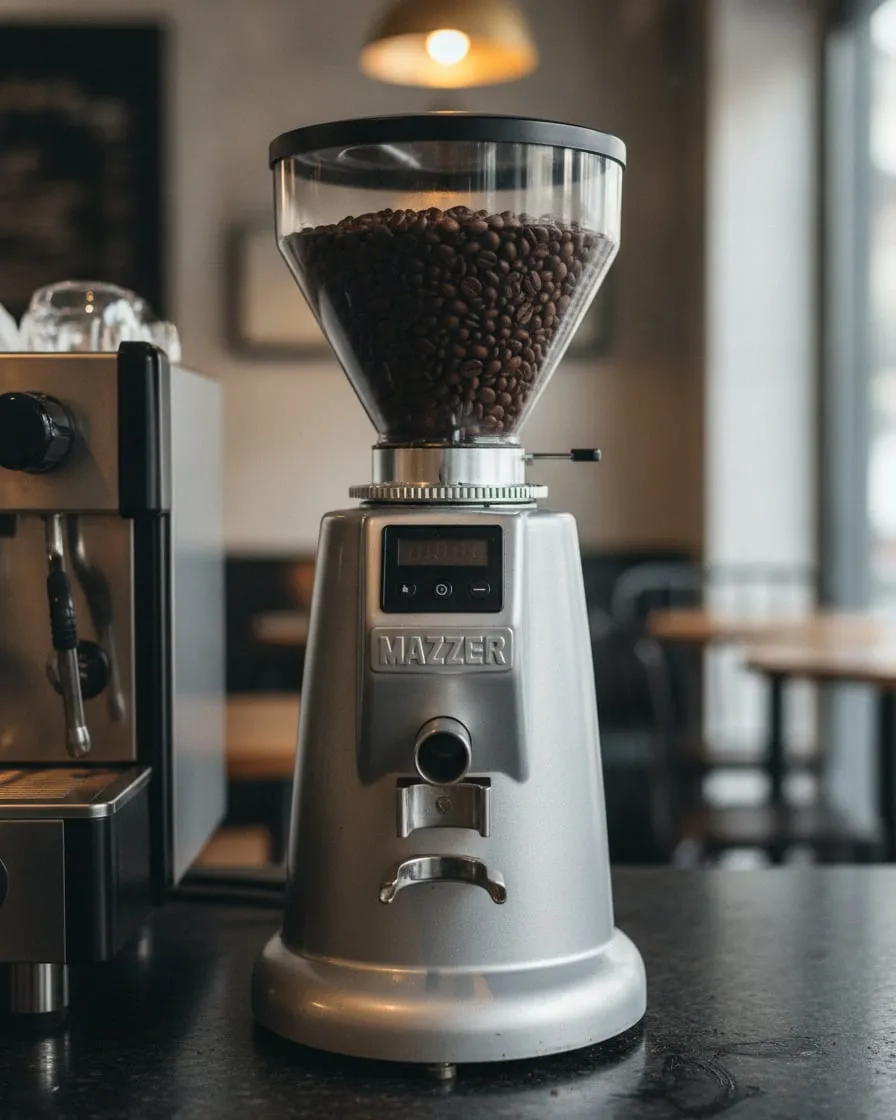
New burrs on a dirty carrier sit crooked, and no setting on the collar fixes that. The seat goes back to bare metal before a burr is screwed down.
Cleaned and oiled at every burr change, as Mazzer’s own procedure says. A collar that turns smoothly is one a barista will adjust instead of leaving alone.
Springs, sector plates, switches and capacitors for a twenty-year-old Super Jolly are stock items at US parts houses. The casting does not wear out.
A V-series grinder that will not start, or one that sprays, is often carrying a part from an older model. That is checked before a fault is assumed.
Mazzer builds its grinders in Italy, and La Marzocco USA has imported and distributed them for more than twenty years. The design barely changes: a heavy cast body, a threaded collar that sets the grind, burrs screwed to a carrier. That is why a twenty-year-old Super Jolly is still worth repairing. It is also why the faults are the same ones every time: worn burrs, a dry collar thread, a tired capacitor, a blocked outlet.
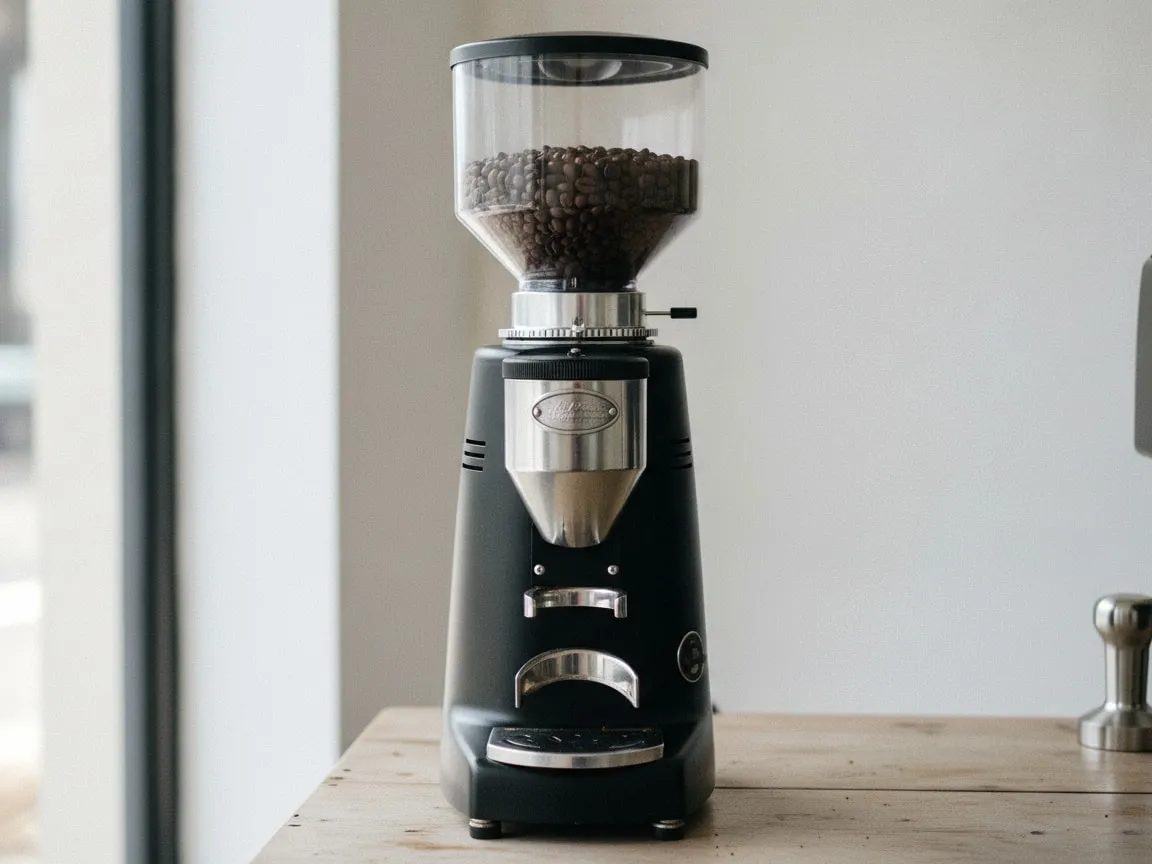
64 mm flat burrs, 350 W. The V Pro runs burr set 233M, which Mazzer rates at 400 kg of coffee. The smallest Mazzer most cafes buy, and the one most often asked to do a bigger grinder’s job.
83 mm flat burrs, 650 W, about 21 kg, double fan cooling. The Major V runs at 1,600 rpm on US power. The VP turns slower, at 1,080 rpm, on burr set k151H, rated at 1,200 kg against 600 kg for the standard 151A.
63 mm conical burrs, 450 W, 500 rpm on US power. The low-speed conical for a mid-volume bar.
71 mm conical burrs, set 186C, 800 W, 500 rpm on US power, 28 kg, double fan. Mazzer rates the set at 800 to 1,000 kg.
The Robur burr set in a 30 kg body, with a belt-driven transmission between the motor and the burrs.
83 mm flat burrs, 800 W, 33 kg and 39 kg. Burr sets rated at 1,200 kg, and a display that reports service alerts and statistics.
The Mini has 64 mm flat burrs on a 250 W motor. The Philos is Mazzer’s single-dose grinder. Both sell above a thousand dollars and both are serviced at the grinder price.
Timer and doser models, and the first Electronic generation. US parts houses still list burrs, capacitors, doser parts and switches for all of them.
Burr wear. Mazzer gives 400 kg for the 64 mm sets and 600 kg for the standard 83 mm set, and says plainly that its burrs cannot be resharpened. On a change the burr seat is cleaned to bare metal, the screws are tightened without forcing them, and the first doses are thrown away.
Mazzer’s own answer: the grind is too fine or the burr outlet is obstructed. Coarsen by two numbers. If that does not bring it back, the chamber and chute come apart. On V and S models four Allen screws open the chamber without moving the grind setting.
On an older Super Jolly a motor that buzzes at fine settings and will not turn is often the start capacitor. On a Major that hums and then goes dead, the switch and the contactor are checked as well. Tested with a meter, not guessed.
The hopper safety switch. A V or S model will not start without its hopper seated, and hoppers from older Major, Robur and Kony models do not actuate the switch. Check the hopper before anything is opened.
The Grind Flow Control. It is a removable aluminium outlet insert with interchangeable wire dampers, and the wires are easily bent when the insert is pulled out. A damaged damper changes how the coffee leaves the chute. The insert is inspected, and the damper that suits your coffee is fitted.
Coffee dust and old oil in the adjustment thread. Mazzer’s procedure has the thread cleaned and oiled at every burr change. After new burrs the contact point is found and the grinder is checked five notches back from it.
On the old doser models the lever return spring slips or breaks, and the tab on the sector plate bends. Small parts, still available.
The service figure is the same for a Mini and a Robur. A burr set is added only if the old one has run past Mazzer’s kilogram figure.
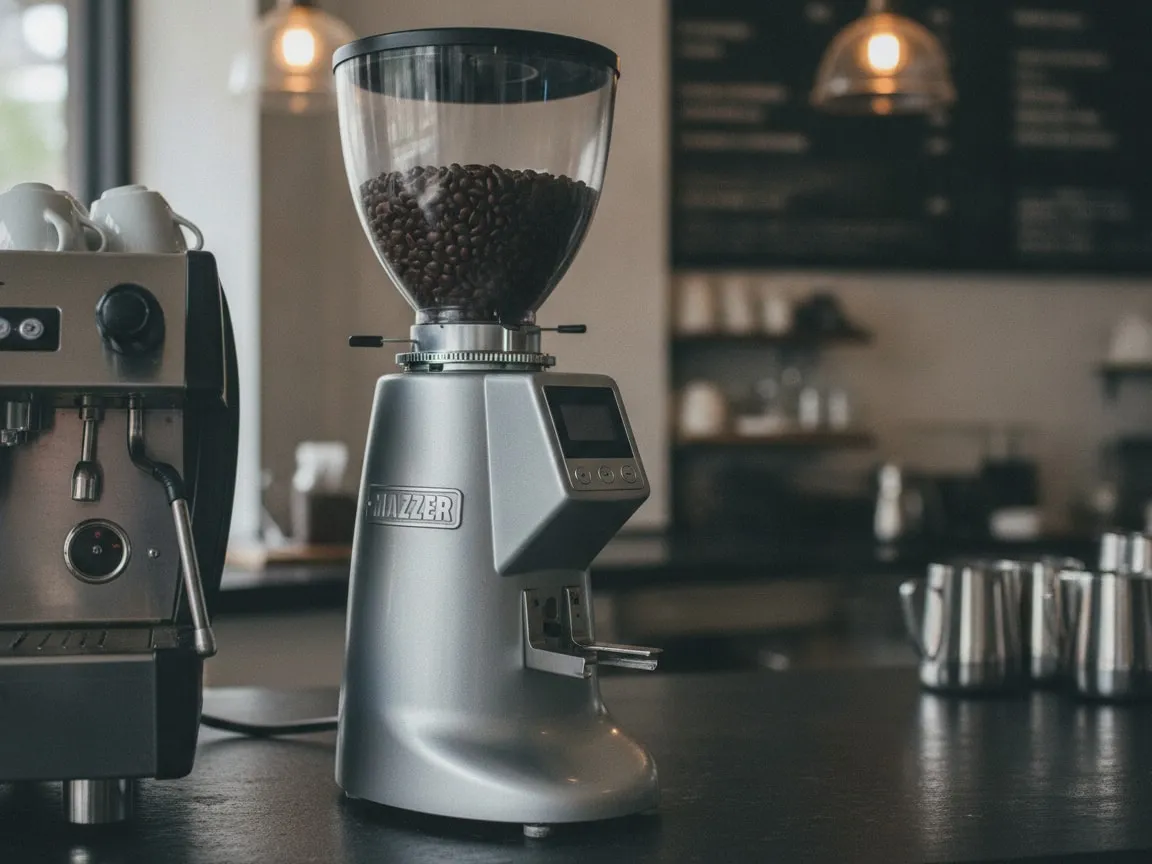
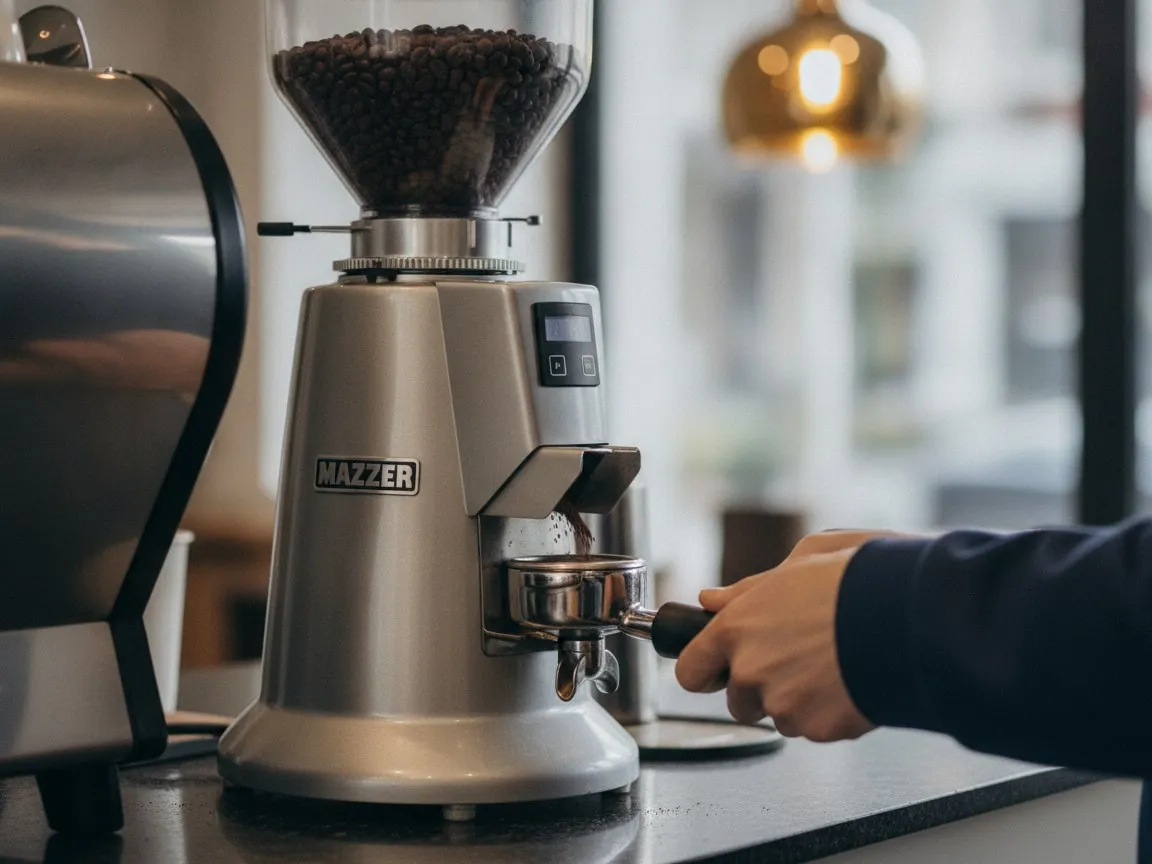
A Mazzer grinder is collected by courier or serviced where it stands, and the coverage is the same for both: Mazzer repair in Hollywood, Mazzer repair in Long Beach and Mazzer repair in San Diego. Same prices in every one of them — 25 cities across six counties.
A typical call on a Major V: shot times have crept and the barista has been going finer for weeks, until one morning the motor runs and nothing comes out. The chamber is opened with its four screws. The outlet is packed solid. The burrs are measured and the coffee through them is added up from the weekly order: well past 600 kg on the standard set. New burrs on a cleaned seat, thread oiled, contact point found, first doses discarded. About 90 minutes on the bench.
Most bars with a Super Jolly bought the wrong Mazzer. Its burrs are rated for 400 kg, and a shop grinding 10 kg a week is through them in nine months. The same shop on a Major VP would change burrs once in more than two years. If you are replacing Super Jolly burrs twice a year, stop buying burrs and move up a size. Until then, replace them on schedule. A worn 64 mm set costs you more in bad shots than the new set costs.
Burr life is published in kilograms, not years: 400 kg for a Mazzer Super Jolly, 6,000 kg for an EK43. How to tell worn from dirty, and who should do it.
Usually yes, if the fix costs under half a replacement and the machine has years left. The arithmetic we run by machine class, and when to buy new instead.
Six to eight years for an entry machine, twenty-plus for a prosumer one. The build, the water it drank and whether anyone serviced it set the number.
Every figure on this page is ours to stand behind — who we are and what we're licensed for.
Tell us your Mazzer model and what's wrong. We'll respond within the hour with a diagnostic estimate and ETA.
Three fields. We call or text back — Mon–Sat · 7am–9pm, Emergency · 24/7. Urgent? Call (424) 352-8838.