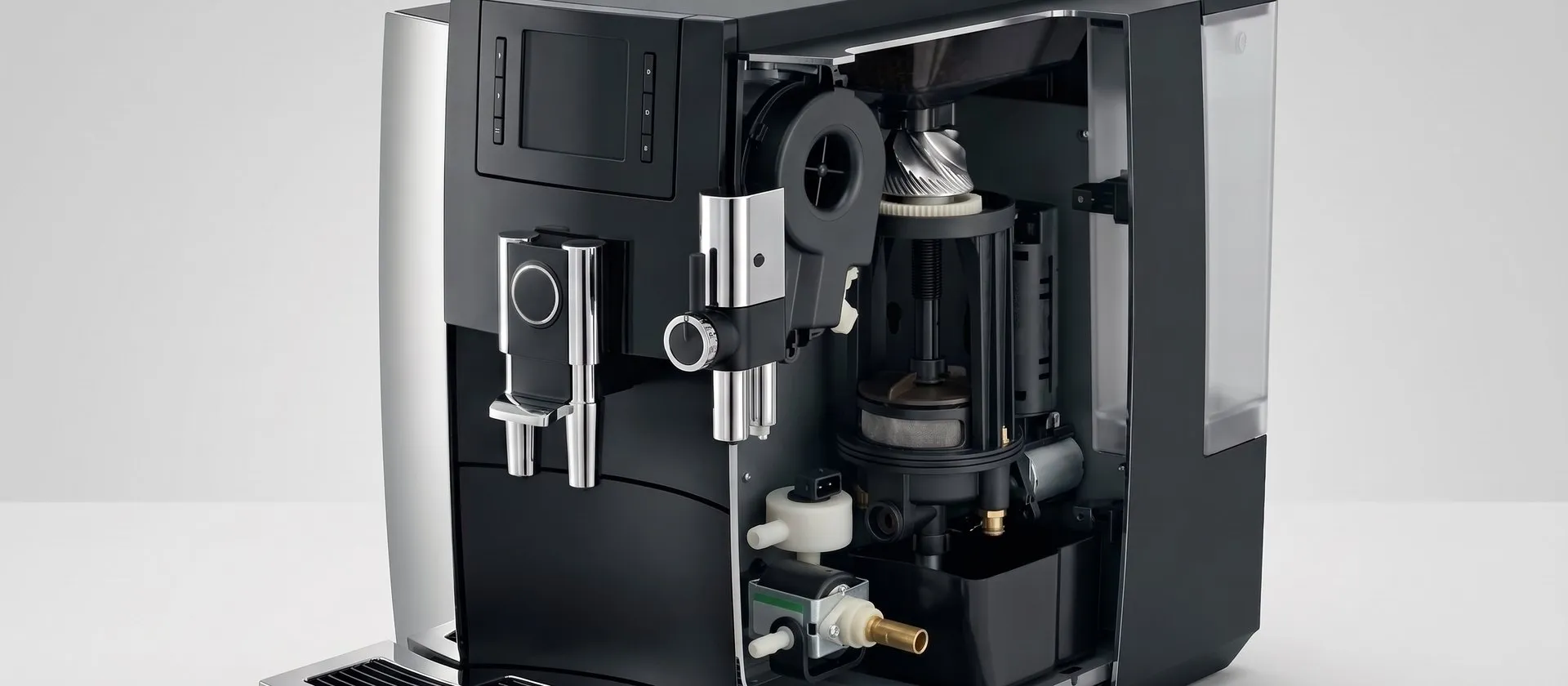
Jura E8 parts diagram
Interactive cutaway of the JURA E8: tap a part to see what it does, follow beans and water from grinder to cup, then see six months without service.
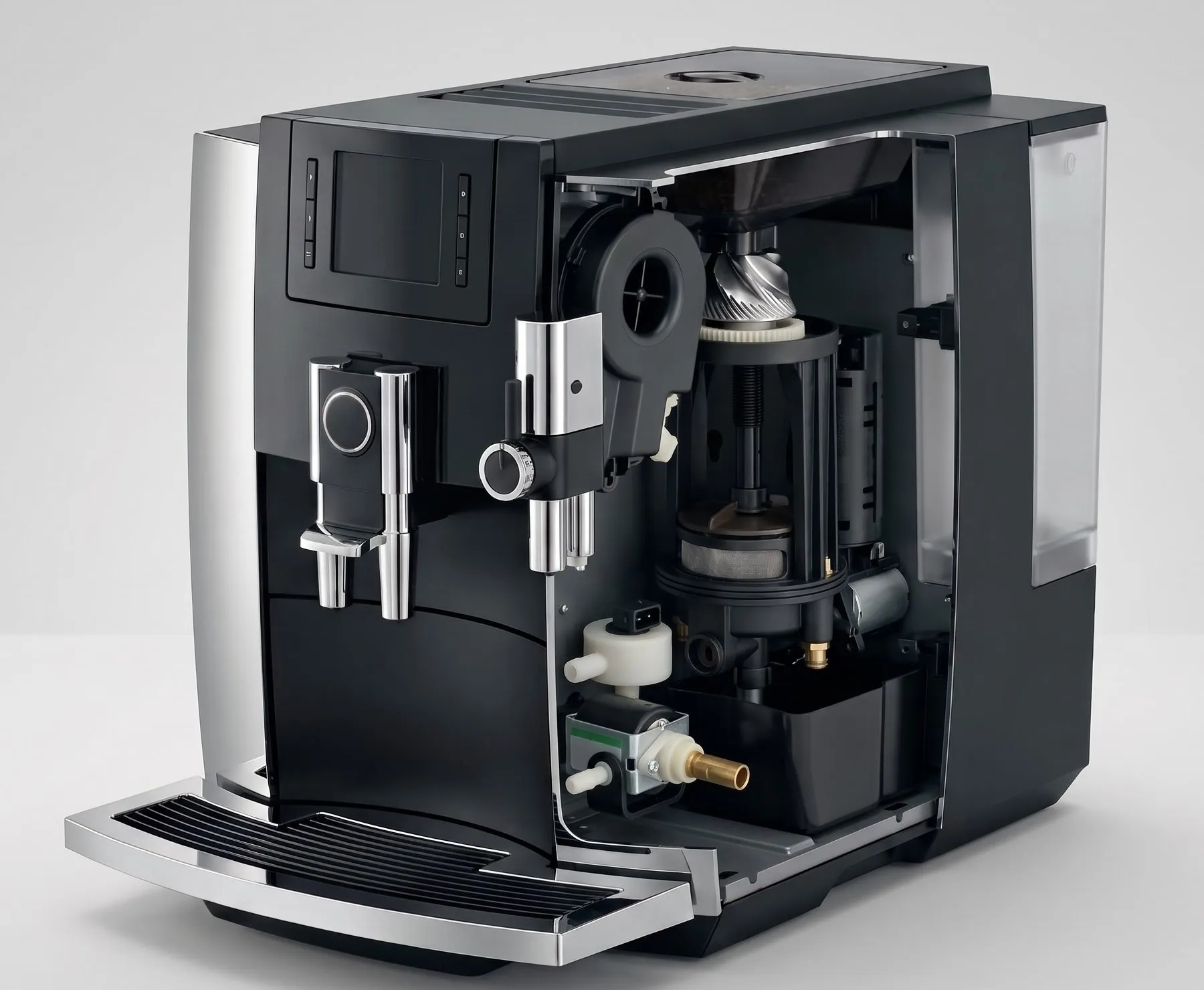
A super-automatic hides everything. You press a button, the machine grinds, tamps, brews and throws the puck away, and the only part you ever touch is the water tank. The picture below is the E8 with its left side off, the view a technician gets after eight screws. Tap any part: the card beside the picture says what it does and how it fails. Press Start and the beans and the water light up along their real route, grinder to cup. Press Milk foam and the same heater makes steam instead. Then press the red button for the same E8 after half a year on LA water behind a used-up filter cartridge, with real photographs next to each part.
Reading the picture
The hoses follow the real plumbing: from the tank through the flow meter into the pump, up into the thermoblock, across to the top of the brew unit, and from the drainage valve down to the tray. The dotted sections run behind parts you cannot see from this side. The dotted rings on the front are the six buttons and the screen; tap one for the manual’s own description, including the two-second hold that opens a drink’s settings.
No stock art went into this. Every component is a render built from photographs of the real E8 part, set where the part sits in the chassis, and the hover outlines trace those shapes. Two things are simplified on purpose: the wiring is left out, and the brew unit is drawn where it stands when the chamber is open, not mid-cycle.
The beans and the water, in order
The grinder comes first, and it is the part most owners never think about. Conical burrs under the bean container grind 5 to 16 g for each cup, depending on the strength you chose, and drop it down a chute into the brewing chamber. The grind switch under the bean cover only moves while the grinder runs. Turn it on a stopped grinder and a bean gets pinched between the burrs; the next sound is the motor stalling.
The brew unit closes around the grounds, a piston presses them into a puck, and only then does the pump start. Water leaves the tank, passes the flow meter, a paddle wheel whose pulses the board counts, and goes into the thermoblock. There is no boiler. The aluminium block heats water on the way through, which is why the E8 is ready about half a minute after switch-on and why the same block makes steam for milk. For espresso the pump pulses, Jura’s Pulse Extraction Process, so a small dose sees the water for longer.
Hot water enters the brew unit from the top and the coffee leaves through the screen at the bottom, then along a hidden pipe to the spout. When the cup is done the drainage valve on the side of the brew unit opens, the last water goes to the drip tray, the piston pushes the puck up and an ejector flips it into the grounds container. The machine counts: after 16 it asks you to empty the container, and it only resets that counter if you empty it with the machine switched on.
Six months without service
The red button rewrites every step for a neglected machine, and each part card then pairs a clean photograph with a neglected one. Most of the neglected photographs are a Jura E6 off our bench, and that is not a cheat: the E6 and the E8 share the brew unit, Jura part 72521, the grinder and the drainage valve. The screen with coffee crust closing its holes came out of a machine whose owner had never run a cleaning tablet. The drainage valve with crust on the pin is from the same machine, and it was weeping into the tray for months before it stuck.
The honest version: the E8 does not fail because of one dramatic part. It fails because three slow things happen at once: coffee oil dries on the brew unit, dried milk closes the frother, and scale grows in the thermoblock behind a filter cartridge nobody changed. Owners read the result as a dead machine. On the bench it is a brew unit service, $280-$520 when the unit is far gone, a milk system clean at $220-$420, and a descale. The thermoblock itself, at $320-$580, is the one we try hardest to avoid replacing, and a descale in time is what avoids it.
The grinder is the quiet one. Burrs on a home machine do not wear out; the chamber packs with fines and oil until the dose drops and every cup is thin. That is a clean, about 40 minutes, and only a real burr change lands at $220-$380. A pump that is loud with weak flow is almost never the pump: it is air in the line or scale downstream, and the published range for the pump, $240-$340, is mostly the diagnosis.
The two cleanings people confuse
The cleaning tablet is a coffee-oil job. The screen asks for it, you drop a Jura tablet into the ground coffee funnel, and the machine runs water through the brew unit and the spout for about 15 minutes. It cleans the screen, the piston seals and the drainage valve, the three parts in the neglected photographs. It does nothing about scale.
Descaling is the water job, through the tank with three descaling tablets in 500 ml of water, about 40 minutes by the book. With a CLEARYL Smart cartridge fitted the E8 never asks for it, because the cartridge is supposed to keep the scale out. A cartridge is good for about two months of water in most of Los Angeles County. Past that the machine still thinks it is protected and the thermoblock cutaway in the diagram shows what has been growing inside. If you have not changed the cartridge in a year, run a descale before you call anyone.
A typical call
A JURA E8, three years old, from a kitchen in Long Beach. The complaint was espresso coming out in drips and a machine that stopped twice a week with an error. On the bench the brew unit screen was half closed with coffee crust, the drainage valve pin was coated and sticking, two O-rings on the piston had gone hard, and the frother connector was packed with dried milk. The thermoblock, on a cartridge changed on time, was clean. The fix was a brew unit overhaul with new seals, a drainage valve clean, a milk system strip-down and a grinder clean: the flat $329 bench service we run on the E6 and E8, and the machine went back pulling a 40-second espresso with no errors. No electrical work, and no part changed that had not worn out.
$145 diagnostic — includes pickup from your address and return delivery. It is credited in full toward the repair when you approve the estimate.When the diagram is not enough
When your machine looks like the neglected photographs, it needs a service rather than a part, and the Jura page lists what we do on the E6, the E8, the ENA and the Z line. If the machine stops with an error number, read the brew unit error guide first, because most of those errors are the unit, not the board. Descaled already, with no change? That guide covers the next step. Both repair and preventive maintenance travel by the same courier pickup, Los Angeles being the first stop on the route, and the pricing page carries the current numbers.