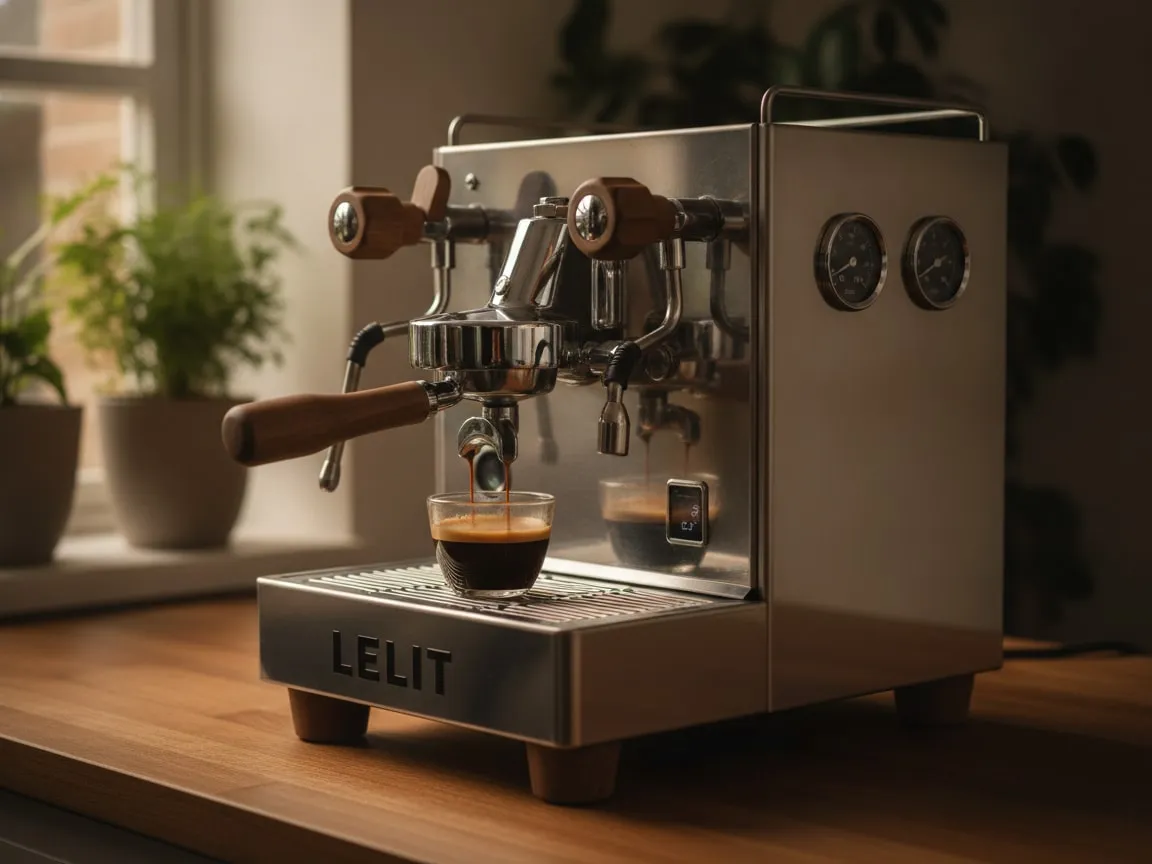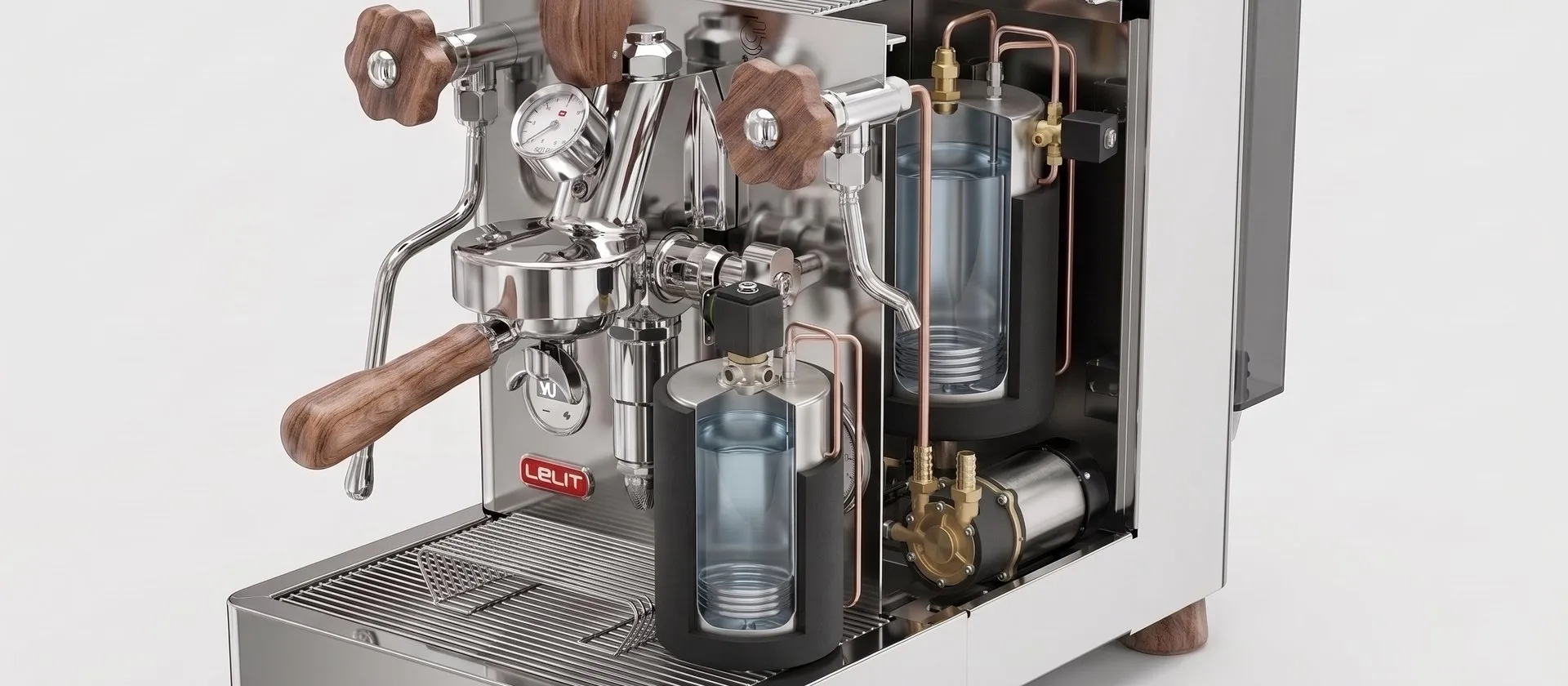
Lelit Bianca parts diagram
Interactive cutaway of the Lelit Bianca: tap a part, follow the water through two boilers to the E61 group and the paddle, then see six months without service.
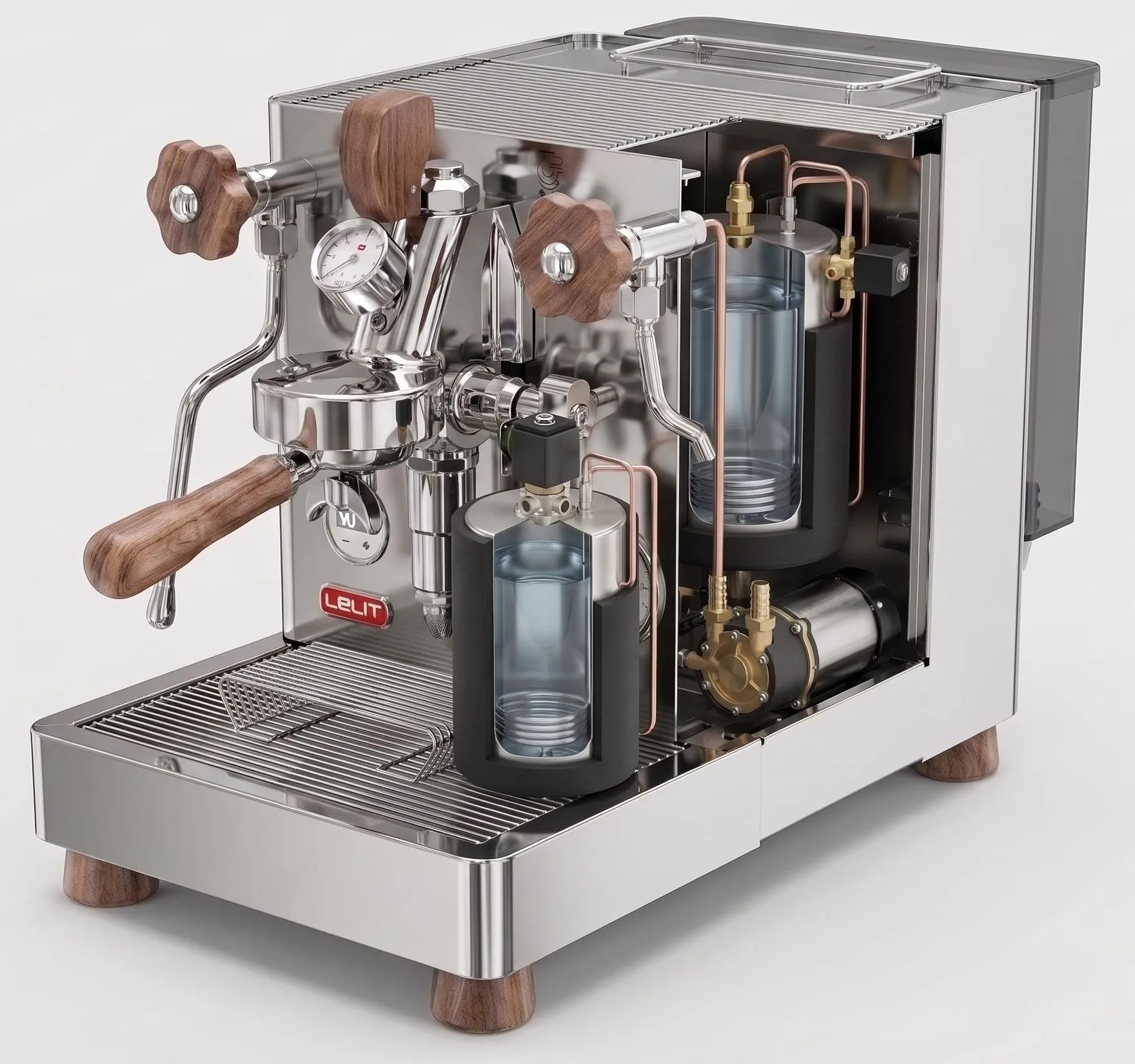
The Bianca is the machine people buy when they have decided the heat exchanger argument is over. Two stainless boilers, each with its own element and its own PID, a rotary pump that whispers, and an E61 group with a paddle on top so you can shape the flow by hand. It is also the machine whose owners understand the least about what is behind the panel, because the display tells them everything is fine. The picture below is the Bianca with its right side off. Both boilers are drawn with a window cut into them, so you can see why one of them scales up and the other one hides it. Tap a part to read what it does and how it dies, hit Start to watch a shot, hit Steam for the other boiler. The red button turns it into the Bianca that arrives on our bench after half a year on LA water with a dead softener filter.
Reading the picture
The copper lines sit where they really run: pump into the coffee boiler and on to the group, from the coffee boiler to the group and back in the thermosiphon loop, from the steam boiler to the steam valve, and from the pump into the steam boiler for the refill. Dotted sections hide behind the front panel. Dotted rings on the front are the controls, the two gauges and the display, each with Lelit’s own words behind it.
There is no stock art here. Each part is a render made from photographs of the real Bianca component and from Lelit’s guide, set where it lives in the frame, and the hover outlines follow those renders. Two things were left out on purpose: the wiring, and the steam boiler’s fill valve, whose story is told by the pump.
Where the water goes
At switch-on the LCC asks for the lever. A 30 second countdown fills the circuit, then both boilers heat on their own loops, 95 °C for coffee and 125 °C for steam from the factory. Lelit’s guide does not give a warm-up time; on the bench the display is there in about ten minutes and the group is honest in twenty, and the second number is the one that matters.
The coffee boiler is the part most owners have never thought about. It is 0.8 litres, completely full, with no steam space and no pressure of its own, and it feeds the group and nothing else. A thermosiphon loop between the boiler and the group keeps the 4 kg of brass at temperature between shots. There is no cooling flush, because the water in that loop is already at the set point; the dance that heat exchanger owners know is simply not there.
Lift the lever and the solenoid opens, the rotary pump starts, and tank water enters the coffee boiler from the bottom, pushing the hot water at the top out into the group. The bypass screw on the pump head sets the pressure the group sees, about 9 bar, and bleeds the rest back. The water passes the needle valve under the paddle, spreads over the screen and into the puck, and the group gauge shows what the puck feels. Lever down, the solenoid flips to discharge and whatever pressure is still in the puck escapes into the tray.
The steam boiler lives its own life. It holds 1.5 litres two-thirds full at 125 °C, about 1.3 bar on the double gauge, with a level probe, an anti-vacuum valve and a safety valve on top. Draw steam or hot water and the probe calls the pump to refill it, 150 seconds allowed before the LCC raises an alarm. Switch the steam boiler off in the menu and the Bianca becomes a single boiler machine that heats faster and uses less power, which Lelit suggests for anyone who does not drink milk.
What six months without a filter does
In red mode every step reads as the neglected machine, and each part card sets a clean render beside a scaled one. All the scaled images are renders, because what scales on a dual boiler is sealed inside two stainless cylinders. They show what the bench shows us: a chalk tide line at the steam boiler’s water level, elements wearing a jacket of scale, a level probe coated until it cannot see the water, and a jet under the paddle packed white.
Here is the uncomfortable part: a dual boiler does not fail like a heat exchanger. It fails quietly. The steam boiler scales first, because that water boils and the minerals stay. The coffee boiler scales slowly, because it is always full and never drained by use, and the PID keeps reporting a good number from a probe that sits in the water next to the scale. The display is the last thing to know. By the time the symptoms arrive, a filling alarm, a hiss from the top that does not stop, a shot that drips with the paddle open, both boilers want draining and descaling, which is the $119 descale line that sits on top of our $429 E61 service, and the reason Lelit’s guide hands the yearly descale to a technician.
The paddle valve is the Bianca’s own wear point: a needle valve that scales and wears at the narrowest point in the brew path, $185-$320 when it needs more than a clean. The group gasket and screen are the same job as on any E61, $145-$195. A probe that drifts or shorts, which the LCC reports by name, lands at $220-$340. The rotary pump is the part we almost never replace: it dies from running dry, not from age, and a tank left empty or not seated is what kills it.
The two cleanings people confuse
Backflushing deals with coffee, and Lelit’s routine is specific: a bag of detergent in the blind basket, lever up for ten seconds and down for ten, ten times, then five rinses without detergent. It scrubs the screen, the cam valves and the solenoid seat. The wand gets its own soak, pulsed ten times in detergent and ten in clean water. None of it touches scale.
Descaling deals with water, and for the Bianca the guide says once a year, by a technician, after an inspection. The diagram is our reason for agreeing. The home tool is the softener filter in the tank, rated for 70 litres: 28 fillings or four months, and a new one after any month the machine stood unused. Lelit prints a water profile too, carbonate hardness between 40 and 75 ppm, and most Los Angeles tap water is well above it. Run it on tap water with no filter for a year and you get the machine in the scaled renders.
A typical call
A Lelit Bianca V2, three years old, from a house in Pasadena. The complaint was the steam boiler filling alarm every few days, a hiss at the top of the machine that the owner no longer noticed, and shots that had slowed to drips with the paddle fully open. On the bench the steam boiler’s level probe was coated until it read nothing, the anti-vacuum valve was held open by a grain of scale, the element on the steam side was jacketed, and the jet under the paddle was packed. The fix was both boilers drained and descaled, a new probe seal and anti-vacuum valve, the paddle valve stripped and cleaned, and a group gasket and screen while it was apart, the $429 E61 service plus its $119 descale line; the Bianca left pulling a 27 second double at 9 bar, alarm-free. No board, no element, nothing replaced that still worked.
$145 diagnostic — includes pickup from your address and return delivery. It is credited in full toward the repair when you approve the estimate.If the picture matches your machine
If your Bianca resembles the scaled renders, book a service rather than a part; the Lelit page lists what we do on the Bianca, the Elizabeth and the MaraX. The same two-boiler logic applies to the ECM Synchronika, the Profitec Pro 700 and the Rocket R58, and one flat-rate E61 service covers them all; the heat exchanger side of the family is on the Appartamento page. If a descale changed nothing, this guide is the next read. Repair and the bench service share one courier run that begins in Los Angeles; current numbers live on the pricing page.