Rocket Appartamento parts diagram
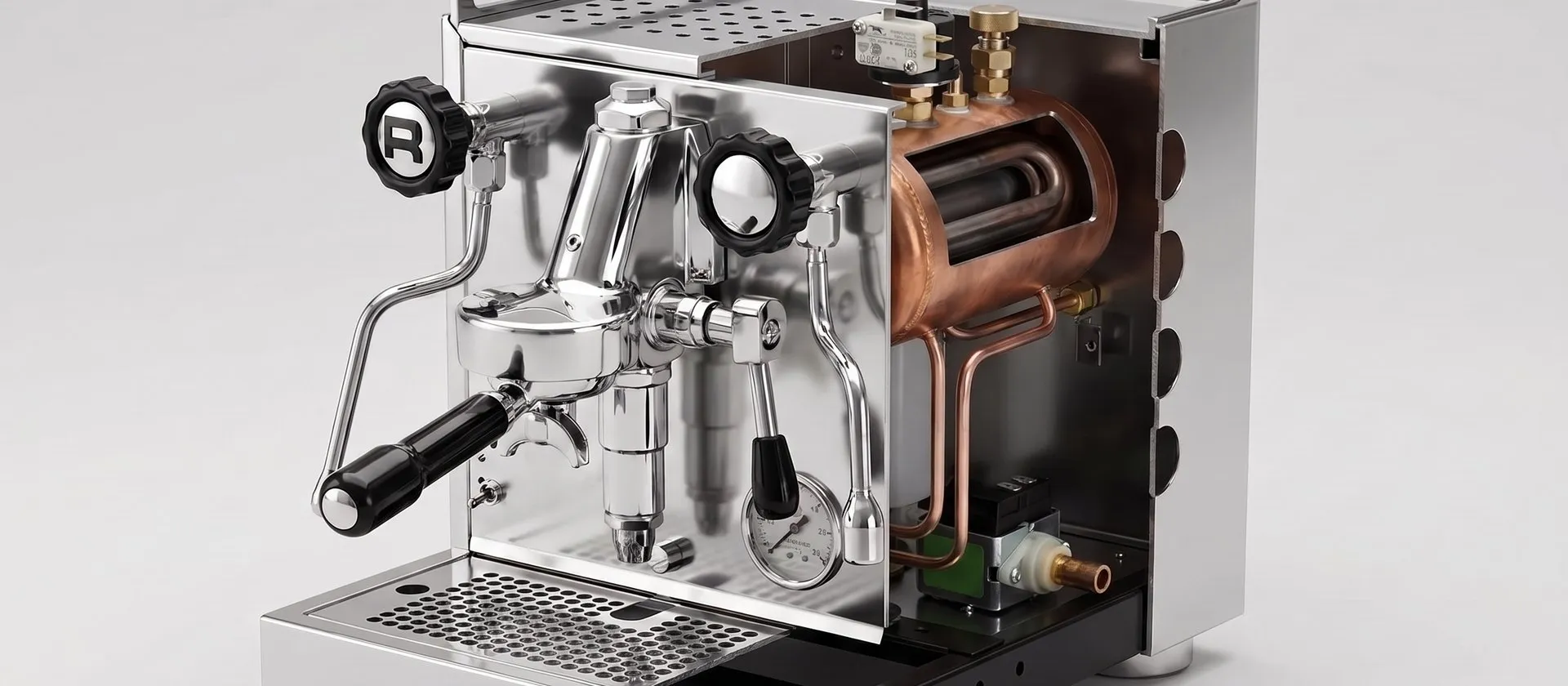
Interactive cutaway of the Rocket Appartamento: tap a part, follow the water through the heat exchanger to the E61 group, then see six months without service.
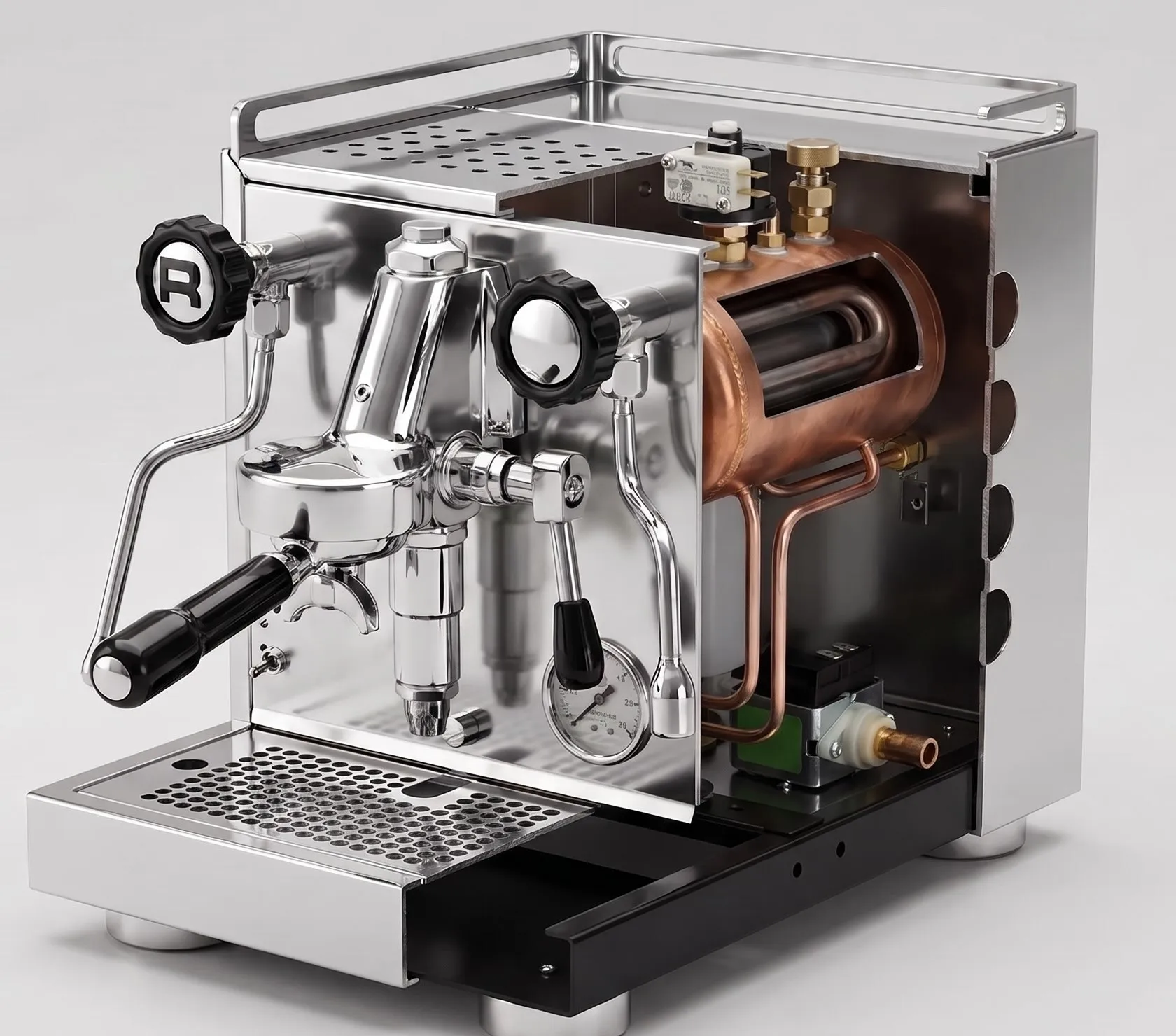
The Appartamento is the smallest machine Rocket makes and the one we see most, and it is built around an idea from 1961: a single copper boiler with a tube running through it. Steam comes off the top of the boiler, brew water passes through the tube and borrows the heat on the way, and a brass group the size of a fist keeps everything at temperature with no electronics at all. The picture below is the machine with its right side off. The boiler is drawn with a window cut into it, because the tube inside is the whole story. Tap any part for its job and its failure mode, press Start for the shot from switch-on to lever-down, press Steam for the boiler side. The red button shows the same Appartamento after half a year on LA tap water with no softener pouch in the tank.
Reading the picture
The copper lines are drawn where they run: from the boiler to the back of the group, the thermosiphon loop that never stops moving; from the pump up into the heat exchanger tube; and from the expansion valve back to the tank. The dotted sections are behind the front panel. The dotted rings mark the controls and the gauge; tap one for the manual’s own words on it.
No stock art went into this. Every part was rendered from photographs of the real component and from Rocket’s own parts list, placed where it sits in the frame, and the outlines you hover over trace those shapes. Two simplifications are deliberate: no wiring is drawn, and the boiler fill circuit is folded into the pump’s story rather than given its own valve.
The water, in order
Switch on and the pump runs before anything else. It fills the 1.8 litre boiler to a level probe, the probe gets wet, the pump stops and the 1200 W element starts. The manual says 15 to 18 minutes to ready and it means the group, not the gauge: the gauge reaches 1 bar well before the 4 kg of brass on the front is honest.
While the boiler heats, the thermosiphon loop starts by itself. Water inside the heat exchanger tube is heated by the boiler water around it, rises through the upper pipe into the group, cools against the brass, sinks back down the lower pipe. No pump, no sensor, no board. It is the reason an E61 holds temperature between shots the way a boiler twice its size could not.
Lift the lever halfway and a cam inside the group opens the brew valve: water from the loop wets the puck under the loop’s own low pressure, the mechanical pre-infusion that E61 owners talk about. All the way up, the lever closes a microswitch and the pump starts. Tank water enters the tube, crosses the boiler in about a second at 120 °C, and rises to the group. The expansion valve on the pump outlet bleeds everything above 9 bar back to the tank; that valve, not a gauge, is where brew pressure lives on this model. Lever down, the cam closes the brew valve and opens the discharge, and the pressure left in the puck hisses into the drip tray.
What six months without a pouch does
Press the red button and every step is retold for a neglected machine, with each part card pairing a clean render against a neglected one. Every neglected image here is a render, because the parts that scale on a heat exchanger are the parts you cannot photograph without cutting the machine open. What they show is what we find on the bench: a tube armoured in crust where the water flashes hottest, an element wearing a jacket of scale, a mushroom cap with its jet packed white, and a vacuum breaker that will not seat.
The honest version: a heat exchanger scales in a different order from every other design, and most of the folklore about E61 machines is really folklore about scale. The spitting flush that never settles, the shot that slows to drips with the grinder untouched, the hiss from the top that lasts all morning, the warm-up that stretches from 15 minutes to 30: four complaints, one cause. On the bench the tube and the loop are descaled with the boiler drained and the group open, which is why our E61 service carries a separate line for it, $119 on top of the $429 flat rate. A restricted thermosiphon alone, when it is caught before the group suffers, runs $220-$340.
The group is the quiet one. Its gasket hardens on a schedule of four or five years, the portafilter locks further right each month, then it sprays from the rim; that and the dispersion screen are a $145-$195 visit. The pump is almost never the pump: a loud one with weak flow means air in the line or scale somewhere after the pump, and the published range for a true pump failure, $240-$340, is mostly the diagnosis. An element that finally opens after years under its crust lands at $320-$520, and a timely descale is what prevents it.
The two cleanings people confuse
Backflushing is a coffee job. Blind basket in the portafilter, lever up and down a few times, and the discharge path of the group gets scrubbed with the machine’s own water; Rocket’s book says daily, with detergent once a week. It cleans the screen, the cam valves and the three-way discharge. It does nothing for scale, and it reaches nothing behind the group.
Descaling is the water job, and on this machine Rocket’s own position is not to do it at home. We agree, for the reason in the diagram: scale loosened in the tube does not leave by the drip tray, it leaves by the group jet. The home tool is the softener pouch in the tank, about a month of water on the hardness in most of Los Angeles County, and a hardness strip to know when it is spent. A machine that has lived on tap water with no pouch for a year is the one in the neglected renders.
A typical call
A Rocket Appartamento, four years old, from an apartment in Silver Lake. The complaint was a flush that spat for ten seconds, shots that had slowed to drips, and a hiss from the top that the owner had stopped hearing. On the bench the heat exchanger tube was half closed with scale, the mushroom jet was packed, the vacuum breaker was held open by a grain of crust on its pin, and the group gasket was hard enough to crack with a fingernail. The fix was a boiler-drained descale of the loop, a group strip with a new gasket and screen, a new breaker valve and a pressure check at the expansion valve, which is the $429 bench service with the $119 descale line, and the machine went back pulling a 28 second double with a three second flush. Nothing electrical, and only the worn parts replaced.
$145 diagnostic — includes pickup from your address and return delivery. It is credited in full toward the repair when you approve the estimate.If the picture matches your machine
A machine that looks like the neglected renders is due a service, not a part, and the Rocket page lists what we do on the Appartamento, the Giotto, the Mozzafiato and the R58. The same heat exchanger logic applies to the ECM, Profitec, Bezzera and Lelit E61 machines, and the E61 service is the same flat rate for all of them. Descaled already, with no change? That guide covers the next step, and the lifespan guide covers when a twelve-year-old E61 is still worth it. A repair and the bench service ride the same courier, which starts its route in Los Angeles, and the pricing page has the current numbers.