No Pressure After Repair? Check the Coffee
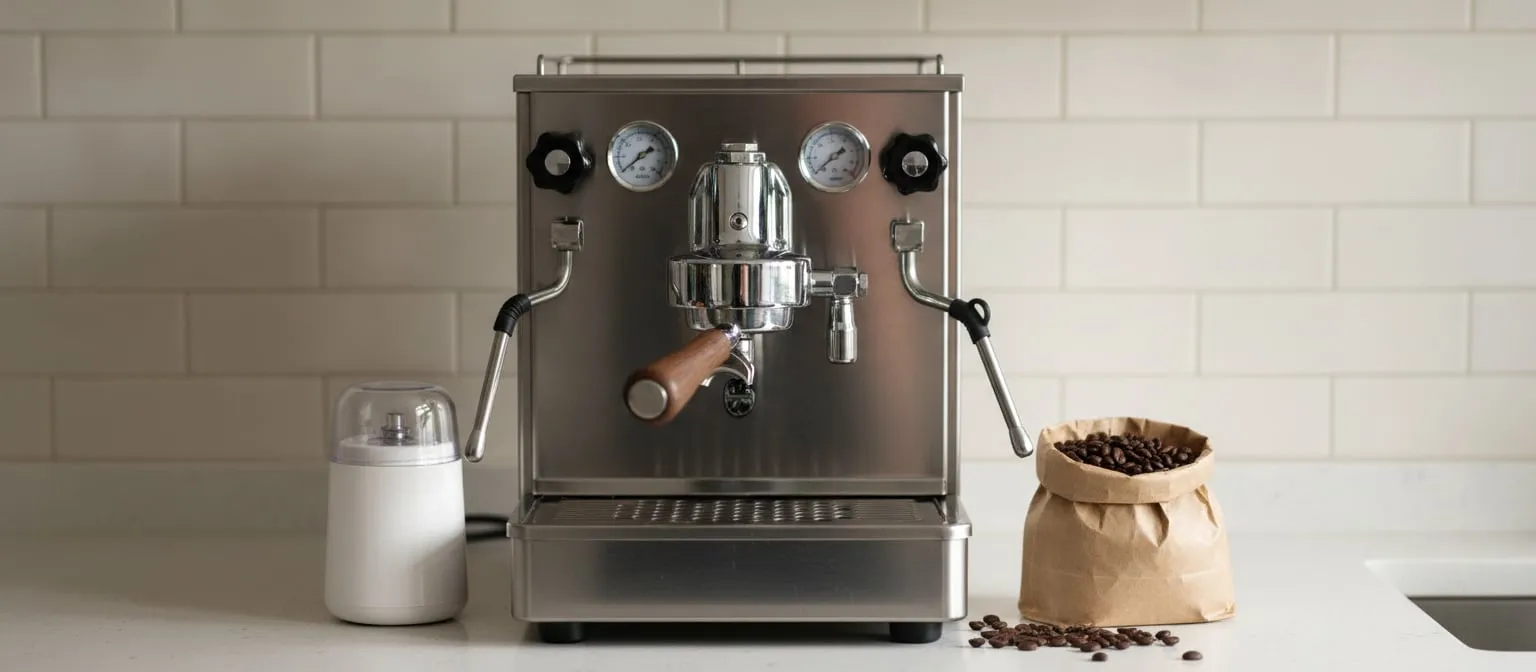
Five checks of the coffee before the machine gets the blame: the grinder, the age of the grounds, how fine, how much, how tamped. A photo per step.
This page is for the owner of a machine with a portafilter who presses the same button as always and gets a thin, fast, pale shot, or no shot at all, and reads the gauge as proof that the pump is weak. It is written from the return visits, because the machine in that story is usually fine. The checks below are about what goes into the basket, not what is inside the machine. If the machine is dead, cold or silent, start with the ten checks on the self-check page instead.
Here is the visit that made us write it. A dual-boiler machine came back from the bench set to a little over 10 bar at the pump. The technician plugged it in, let it heat, and asked for ground coffee to show the owner a shot. Out came a four-blade grinder, the kind sold for spices, with grounds in it from before the repair, a month old. The owner’s rule for the dose was “about two thirds of the basket”. The first ten seconds of the shot ran water, then the puck sealed itself like wet clay and nothing more came through. The gauge sat at 10 bar the whole time. The machine was pushing as hard as it should and had nothing it could push through. Had a courier returned that machine instead of a technician, the next message would have read “same problem as before”.
Look at the grinder, not the machine
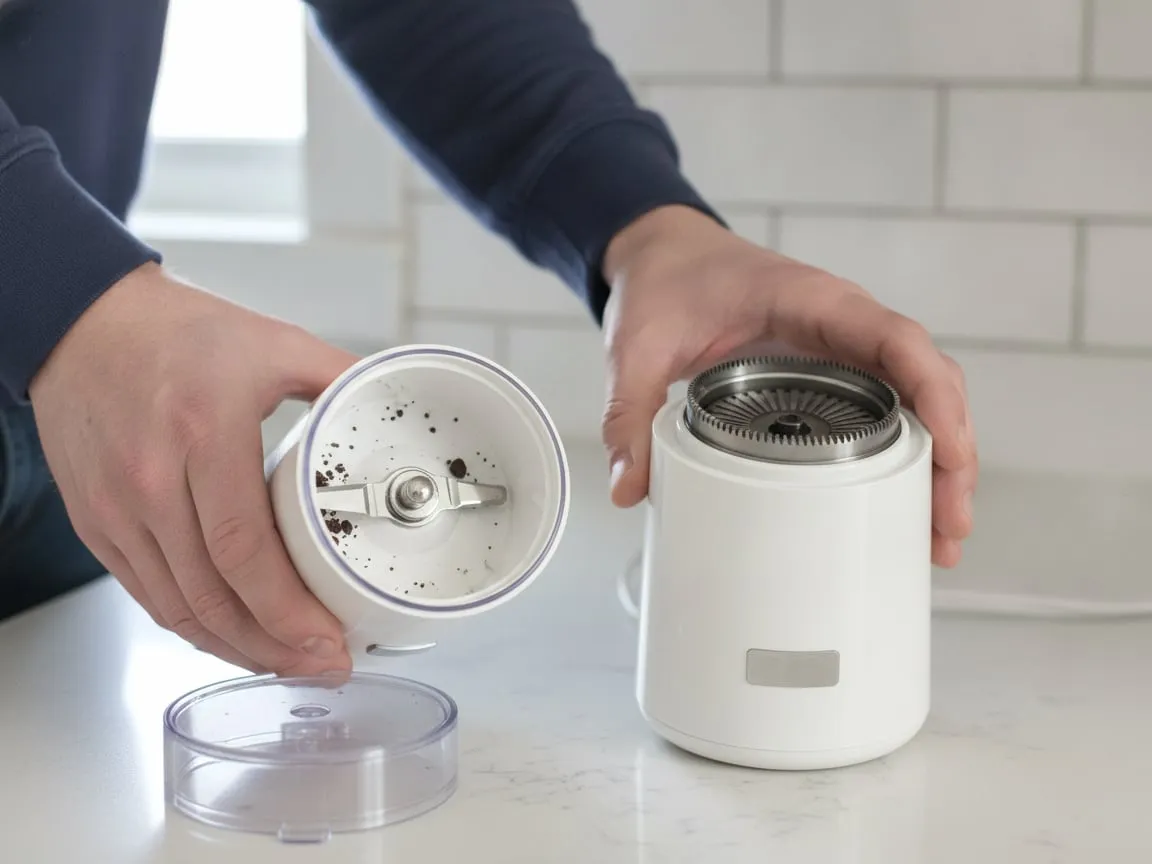
A blade grinder has a propeller. It chops beans at random, and after thirty seconds the bowl holds dust, chunks and a few beans it never touched. The dust packs into a paste that water cannot get through; the chunks leave gaps that water races through. Both happen in the same puck, and the result is a shot that chokes on one side and gushes on the other. No pump setting fixes that.
An espresso grinder has two burrs held a fixed distance apart, and every particle that comes out has passed through that gap. That is the whole difference, and it is why a hand burr grinder beats any electric blade grinder for this job. If you own a machine worth fifty times what the grinder cost, the grinder is the part to change. Coffee ground for espresso at a roaster, used within a week, is the one acceptable shortcut, and only in a non-pressurized basket with a scale on the counter.
Throw out grounds older than a few days
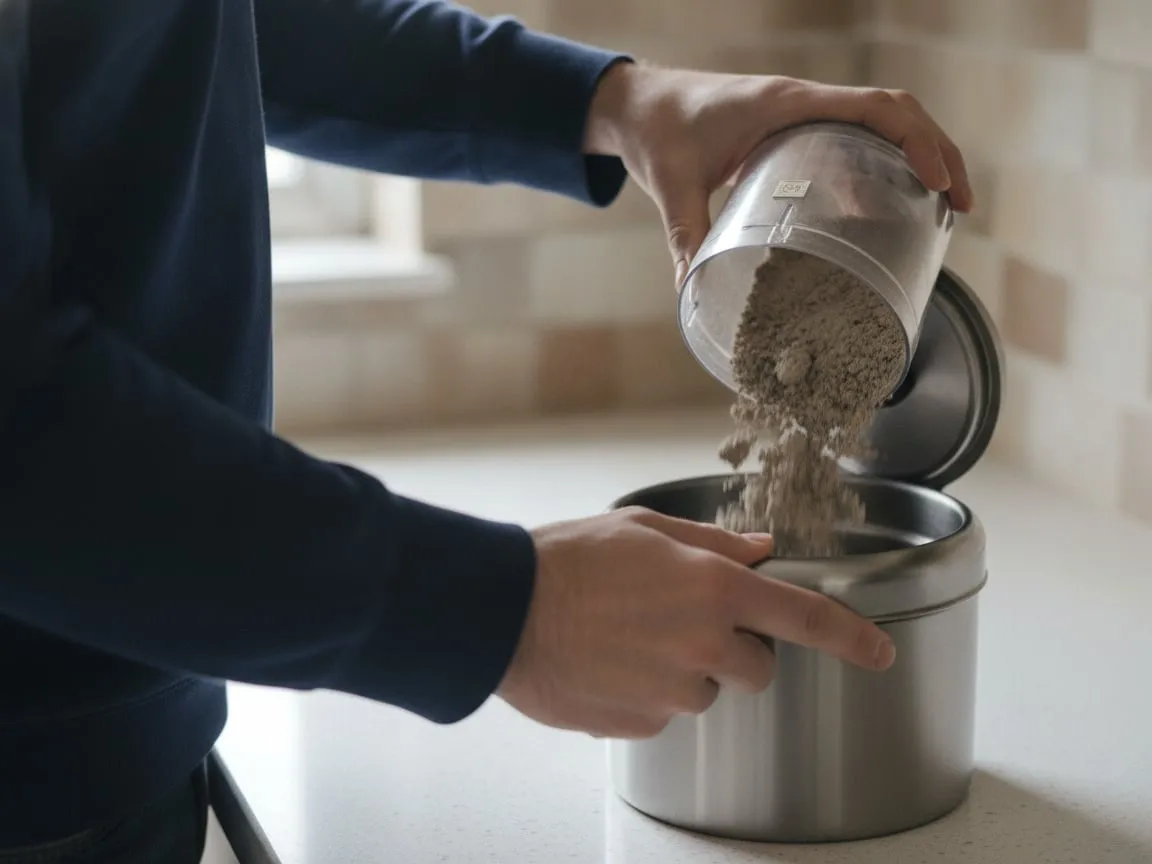
Ground coffee loses most of its aroma within a day and goes flat within a week. The gas that fresh grounds release is also what makes a puck resist the water; stale grounds pour like dust, settle like dust, and the water runs straight through them. The shot is fast, pale, with no crema, and the owner reads it as a pressure problem.
Grounds that sat in an open hopper for a month go in the bin, and so do beans that have been in the hopper for weeks, because the oils on them have gone rancid and the hopper walls are sticky with them. Buy whole beans with a roast date on the bag, use them within four to six weeks of that date, keep them in the bag with the valve, and put into the hopper only what you will grind today. On a dark, oily roast the grinder chute clogs faster; wipe it.
Rub a pinch between your fingers
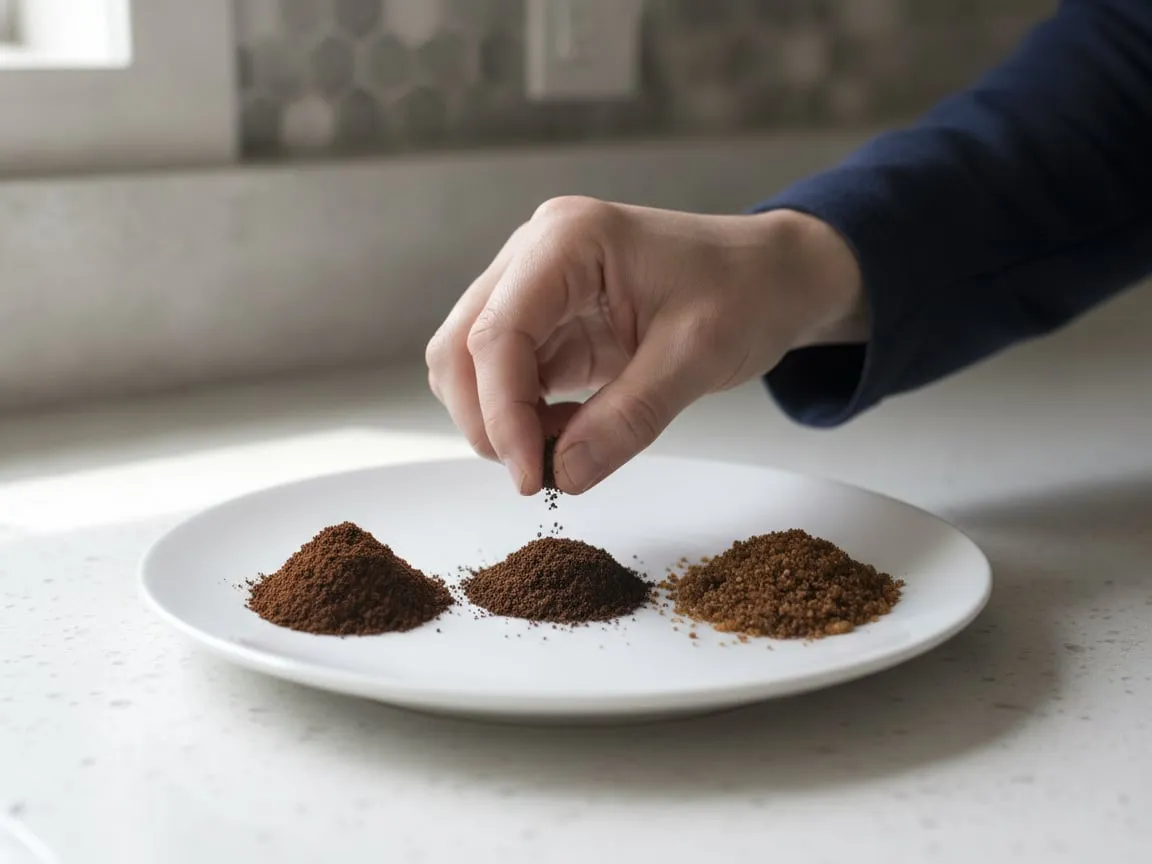
Espresso grind feels like fine sand or table salt. Flour that cakes on the skin is too fine: the shot drips, the gauge pins at the top, and the machine strains against a wall. Grains like raw sugar are too coarse: the shot pours in ten seconds and the gauge barely lifts. Both look like a machine fault from the kitchen side, and neither is.
Move the grind one step at a time, and after each change grind and throw away one dose, because the grinder holds the previous setting in its chute. A machine that has just come back from us needs a step or two finer than the recipe you remember: the pump is back at 9 bar instead of the 11 or 12 it had drifted to, and the group screen and jet are clean. Water moves faster through a clean machine. That is the repair working, and the what changed section of the self-check page explains it part by part.
Weigh the dose: 18 grams, not two thirds
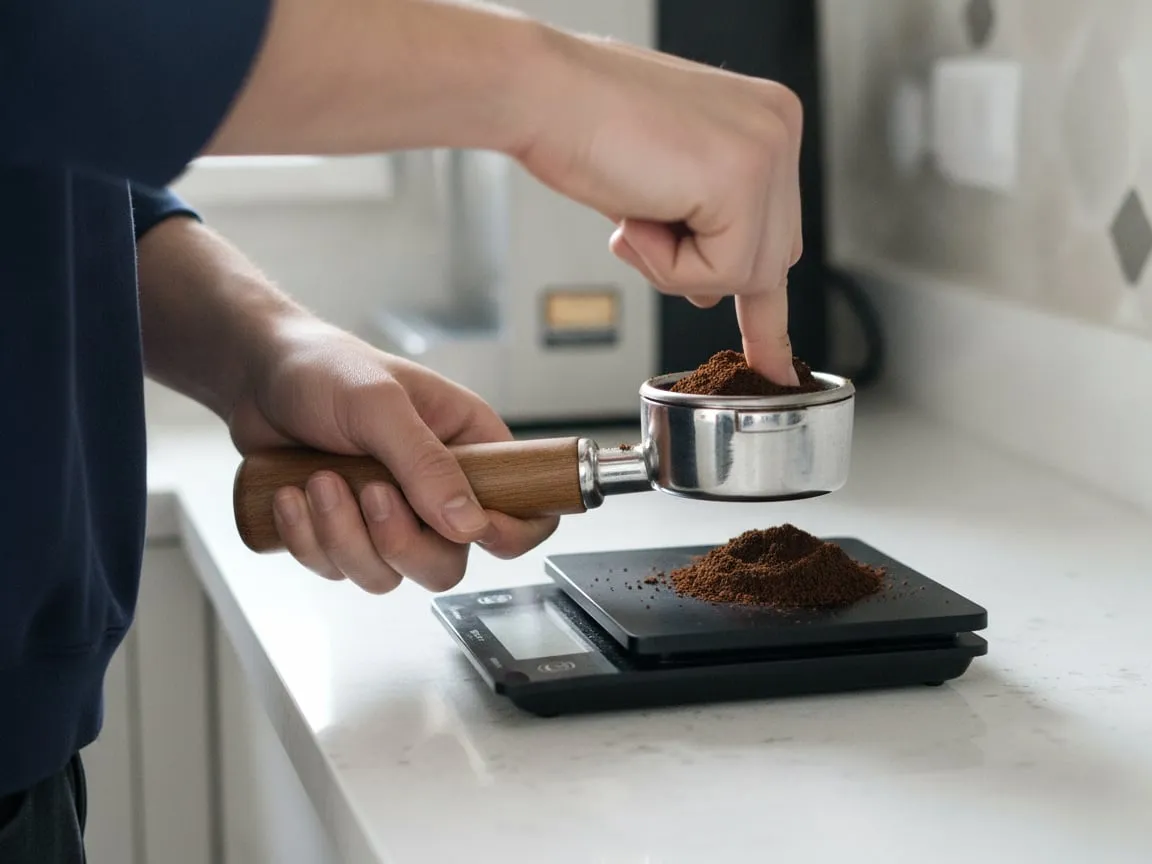
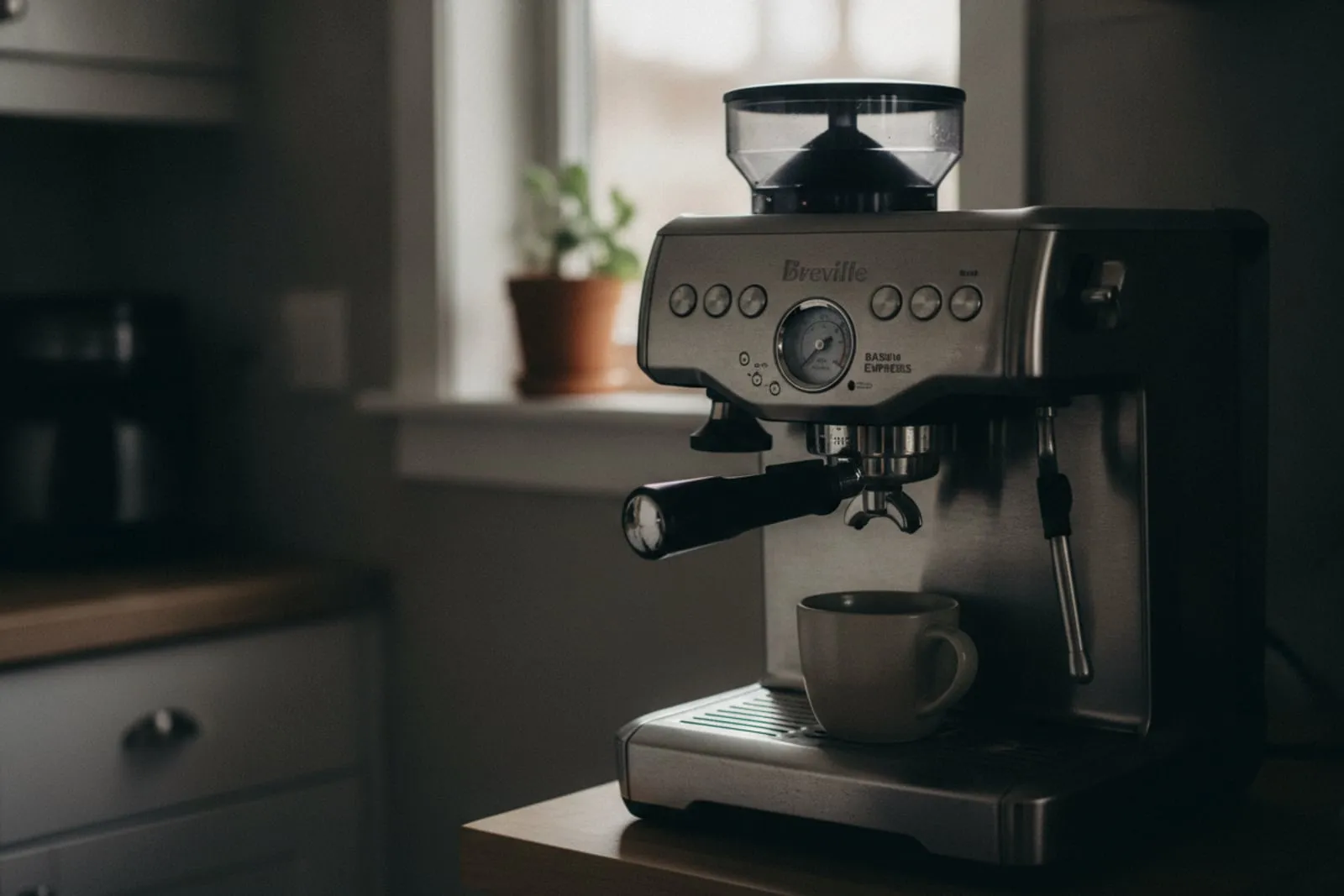
The double basket on a home machine takes 17 to 20 grams of ground coffee. Filled by eye to “about two thirds” it holds 11 or 12. The pump builds pressure only against resistance, and 11 grams in a basket made for 18 gives it none: the water pushes the thin puck aside, the gauge never leaves the low band, and the cup fills with something closer to tea. On a Breville with the built-in grinder the dose comes from the grind amount dial; a dial left near LESS gives 10 or 11 grams at the double setting, which is exactly what we found on a machine that tested fine on our portafilter and “had no pressure” at home.
A kitchen scale that reads tenths of a gram ends the guessing. Weigh the beans in, grind, level the basket with a finger, and the tamped puck should sit a few millimeters below the rim, not at it, so the shower screen does not press into the coffee when the portafilter locks in. If your basket has a single hole under a false floor it is a pressurized basket, built for shop-ground coffee at a looser dose; the basket step on the self-check page shows the two side by side.
Tamp flat, lock in, then weigh the cup
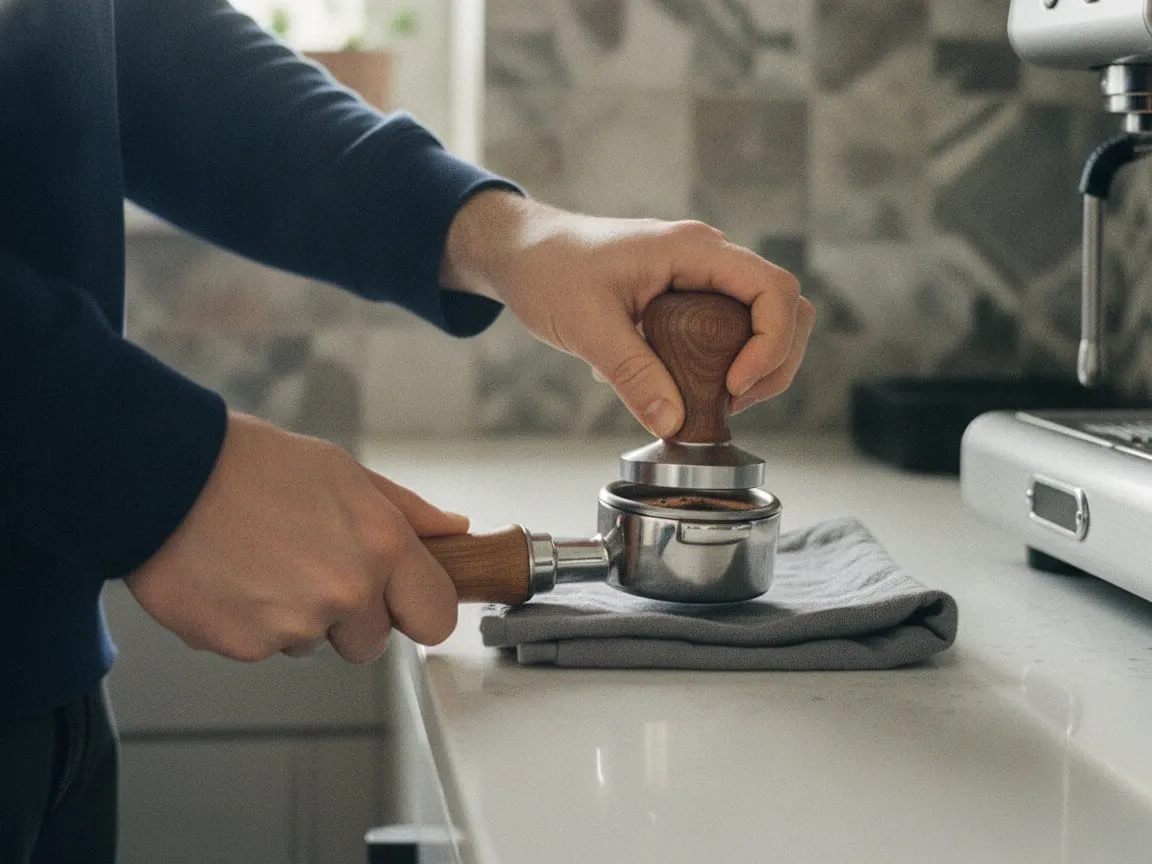
Press the tamper straight down once, with the wrist over the basket and the portafilter flat on the counter. A tilted puck has a thin edge, and water finds the thin edge every time; a puck tamped twice at two angles has two. Then lock the portafilter to the stop, put the cup on the scale, and start the shot.
The starting recipe is 18 grams in, 36 grams out, in 25 to 32 seconds. Stop by weight, not by time. If 36 grams arrive in 12 seconds, grind finer. If they take 45, grind coarser. Taste decides after that, but an owner who can tell us “18 in, 36 out in 14 seconds, fresh beans, burr grinder” has told us in one line what a 20-second video cannot, and that line settles most “it still does not work” messages without a pickup.
When it is the machine
Run the five checks with fresh beans, a burr grinder, 18 grams, a fine grind and a level tamp. Now read the gauge during the shot. If the needle stays down while the pump hums, water is still escaping somewhere easy, and the self-check page covers the three exits: an open steam knob, a portafilter short of the stop, the wrong basket. A needle pinned at the top with nothing in the cup, on a grind that felt like sand, is a blocked jet, a scaled group or a pressure valve set wrong, and that is a bench job.
Film one shot before you adjust anything else, from the gauge to the cup, and send it with the numbers. Labor is under warranty for 30 days after the return, a video gets an answer the same day, and if the machine has to come back inside that window, our courier collects it in Los Angeles at no charge. For a machine that was not repaired by us, the pickup diagnostic is the next step. The $145 diagnostic is credited in full toward the repair when you approve the estimate.
The honest part
Most of the “you did not fix it” messages we get after a return are not about the repair. They are about a machine that was tuned, over years, to compensate for a bad grinder, old coffee and a light dose, and then came back tuned to the factory. The old pressure of 12 bar was forcing water through a puck that should never have held; at 9 bar it does not, and the owner sees a machine that got worse. We could send machines back at 12 bar and hear nothing. We set them to 9 because that is the number the boiler, the gaskets and the group were built for, and because the shot is better there once the coffee is right. The grinder on the counter beside the machine is the part we cannot repair from the bench, and on a return visit it is the part we look at first.