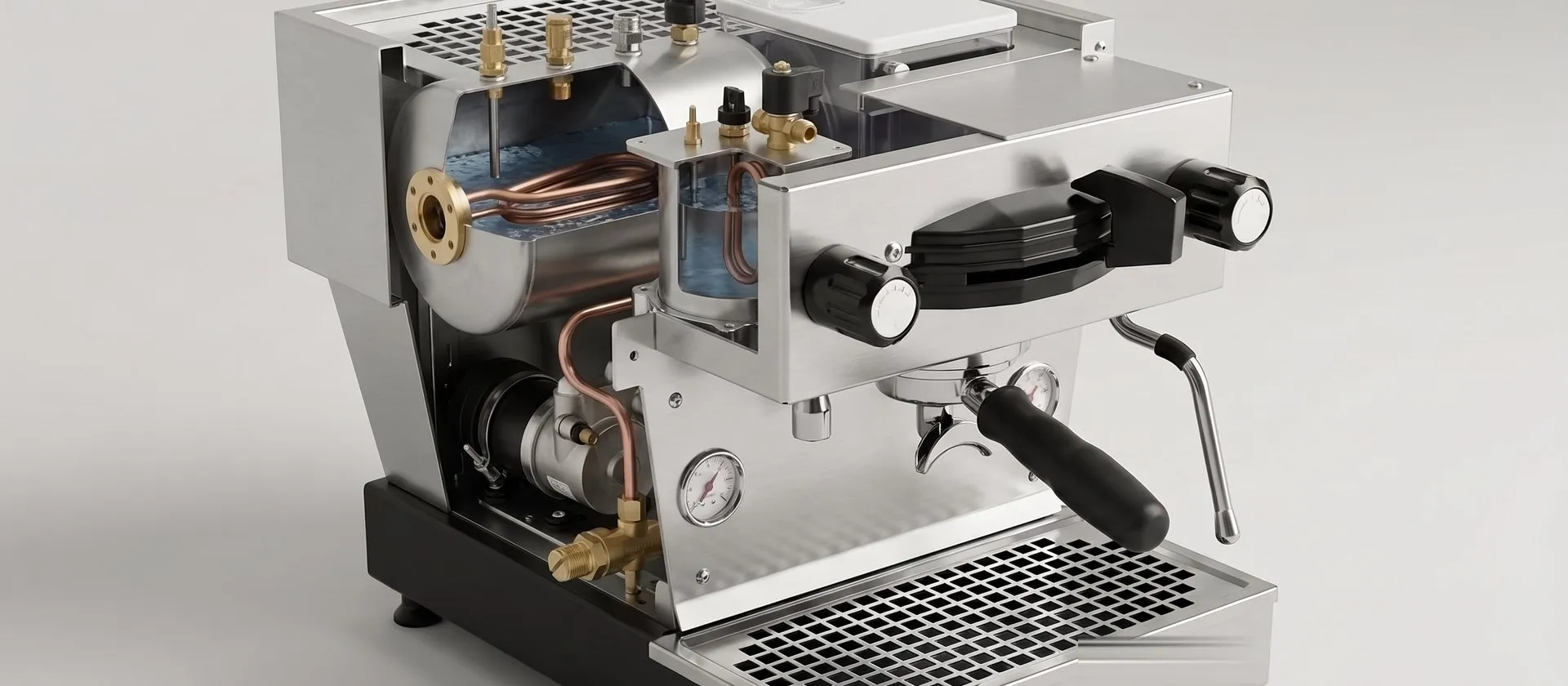
La Marzocco Linea Mini parts diagram
Interactive cutaway of the La Marzocco Linea Mini: tap a part, follow the water through the integrated group and steam boiler, then see six months of LA water.
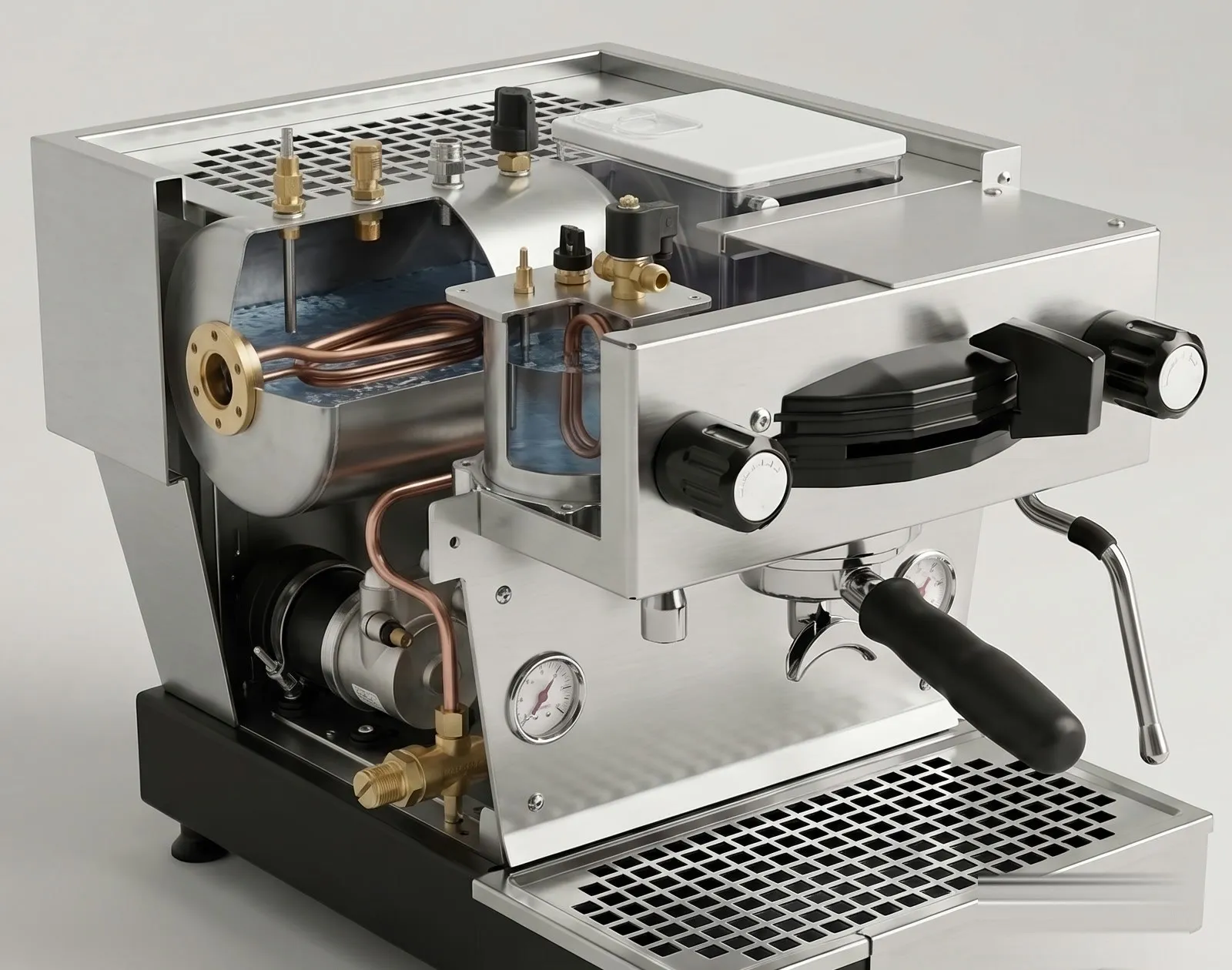
The Linea Mini is a bar machine with one group, shrunk until it fits under a kitchen cabinet, and the shrinking changed nothing that matters. The group is the same saturated design as the Linea PB in the café down the street: a small boiler that is also the group head, with its own element and probe, so the water is made where it is used. Behind it lies a 3 litre steam boiler, a rotary pump on a separate motor, and a valve behind the drain box that most owners have never heard of until the day their drain box is wet. The picture below is the Mini with its left side off. Both boilers have a window cut into them. Touch a part to learn its job and the way it dies, press Start to pull a shot, press Steam for the big boiler. Red turns it into the machine we meet after half a year on Los Angeles tap water with nothing in the reservoir but the water.
What the lines mean
Copper runs where the real pipes run: from the pump up into the integrated group, from the pump to the steam boiler when it refills, from the steam boiler forward to the steam knob. Dotted sections pass behind the front panel. The rings dotted onto the front mark the controls and both gauges, each with La Marzocco’s own numbers behind it.
Nothing here is stock art. Each part came out of photographs of the real Linea Mini component, from the frames of a teardown, and from the parts catalogue, then set where it sits in the chassis; the outlines you hover follow those renders. The wiring was left out, and so was the two-way autofill solenoid, whose work is described by the pump.
From the switch to the cup
The main switch is on the left rear. The pump fills the steam boiler until its level probe touches water, the group is already full, and both elements come on. The red light flashes while the group climbs to about 93 °C and goes steady when it arrives; the blue light reports the reservoir, steady when full, flashing when empty. The manual gives no warm-up figure, so here is ours: the light goes steady at around fifteen minutes and the group is honest at twenty, and only the second number counts.
Something else happens during those twenty minutes that the manual spends two pages on. The integrated group is a sealed boiler full of water, and water expands as it heats, so the group gauge climbs with nobody touching the paddle. Behind the drain box sits a brass expansion valve with an 18 mm hex on it, and it lets a few drops out into the box and stops the needle at 12 bar. A quarter turn clockwise raises that line, counter-clockwise lowers it. Those drops are not a leak. We take two calls a month that turn out to be exactly those drops.
Lock in and move the paddle from right to left. The paddle on this machine is a switch, not a flow valve: a microswitch behind the cover starts the pump and opens the three-way brewing solenoid, and that is all it does. Reservoir water enters the bottom of the group boiler and pushes the hot water at the top down through the dispersion screen, past a 0.8 mm jet, into the coffee. A bypass screw on the pump head decides what the group sees, 9 bar from the factory, 8 to 10 in service, and the right-hand gauge shows it. La Marzocco’s own target is about 60 ml in 25 seconds from a double. Paddle back, and the solenoid flips to discharge so the pressure left in the puck vents down the drain tube.
The steam boiler lives its own life across the back. A pressure switch holds it at about 2.0 bar, which the manual says can run anywhere from 1.3 to 2, and that puts the water at about 127 °C. The right knob opens the steam valve, the left knob draws boiler water through the short spout for rinsing the portafilter, and either one makes the level probe call the pump for a refill through the two-way solenoid and its check valve. On top of the boiler sit the anti-suction valve, which hisses for a minute at warm-up and then seats, and a 2.5 bar safety valve in a stainless cup with a drain tube, the backstop that never opens on a healthy machine.
The quiet failure of a tiny boiler
Switch to red mode and every step is retold for the neglected machine; each part card then pairs its clean render with a scaled one. Every scaled image is a render, since the scale on a Linea Mini forms inside two sealed stainless cylinders. They show what we find on site: a chalk line where the steam boiler’s water stands, a level probe coated until the autofill runs long, an expansion valve seat that weeps, a jet packed white, and the group element wearing a jacket.
The integrated group fails differently from any heat exchanger and the difference is worth understanding. There is only 0.17 litres in there, it is never drained by use, and it never boils, so scale arrives slowly and evenly on the element and the walls. The PID reads a probe that sits in the water, and the probe keeps saying 93 °C while the element under its crust runs hotter and the shot slows a second a month. The red light finds out last. Once the symptoms are loud, a light that flashes for forty minutes, a drain box that is wet at idle, a double that drips at a grind that worked in spring, both boilers want draining and the expansion valve wants a look.
That is the $449 home-commercial service, on site, because the Mini is heavy and often plumbed: both boilers drained through their ball valves, the group descaled, the element and probe checked for scale, the pump bypass set at the group with a gauge in the portafilter, the steam pressure set at the switch. Parts that come up on this machine land where they do on its bigger relatives: the group gasket at $145-$220, a solenoid rebuild at $150-$270, a steam boiler descale on its own at $380-$550, and the rotary pump, which we almost never replace, at $340-$420 when a tank that ran dry has scored its vanes.
Two cleanings, one of them yours
The daily routine in the manual is the one you can do, and it deals with coffee, not water. The dispersion screen comes off its single screw and soaks in detergent. The blind basket goes in with cleaning powder, the paddle runs 15 to 20 seconds at a time until the water comes out clear, and a normal basket rinses the group afterwards. Steam wand wiped and purged after every drink, before and after, because the manual is explicit that liquid can be drawn back into the boiler. The reservoir water changed daily, and inside 90 to 150 ppm hardness.
The periodic routine is the one that drains the boilers, and that is ours. Nothing in La Marzocco’s book describes a descaler, and the diagram above is why we agree: scale loosened in the group has one exit, through the 0.8 mm jet and the screen, and a home descale usually moves the fault rather than removing it. Most Los Angeles tap water sits above the top of the manual’s hardness range, and a reservoir with no softener in it is the direct route to the scaled renders on this page.
A typical call
A Linea Mini, five years old, in a kitchen in Hancock Park, bought with the house and never serviced. The complaint was a red light that took most of an hour to go steady and a drain box that needed emptying every evening though nobody had brewed. On site the group gauge sat at 14 bar at idle, the expansion valve seat was scaled and weeping, the steam boiler had its chalk line and a coated probe, and the jet in the group inlet was half closed. The fix was the home-commercial service with both boilers drained and descaled, a new expansion valve rather than a cleaned one, the jet and screen cleared, and a group gasket while it was apart; the group gauge stopped at 12 again, the red light went steady in sixteen minutes, and a double ran 27 seconds. Nothing on the board, nothing on the pump.
$250 on-site diagnostic — a technician comes to you. It is credited in full toward the repair when you approve the estimate.When your Mini looks like the red renders
When the scaled renders look familiar, book the service rather than a part; the La Marzocco page covers the Mini alongside the GS3 and the bar machines it is built from. The other three designs in this series are the Bianca with two conventional boilers, the Appartamento with its heat exchanger, and the Barista Express with a thermocoil. A descale that changed nothing has its own guide. Repair and the on-site service run across Los Angeles and the counties around it; today’s numbers sit on the pricing page.