Hard Water and Your Espresso Machine
The symptoms of scale in an espresso machine in the order they appear, from rings on the drip tray to a dead element, and what a descale recovers at each stage.
Scale does not arrive all at once. It builds in a fixed order, from the hottest surface outward, and each stage has a symptom the owner can see from the outside of the machine. Knowing the order tells you two things: how far along your machine is, and whether a descale will bring it back or whether it is time for the bench. This page is that order, written from what we find when the panels come off in LA County.
Stage one: the rings
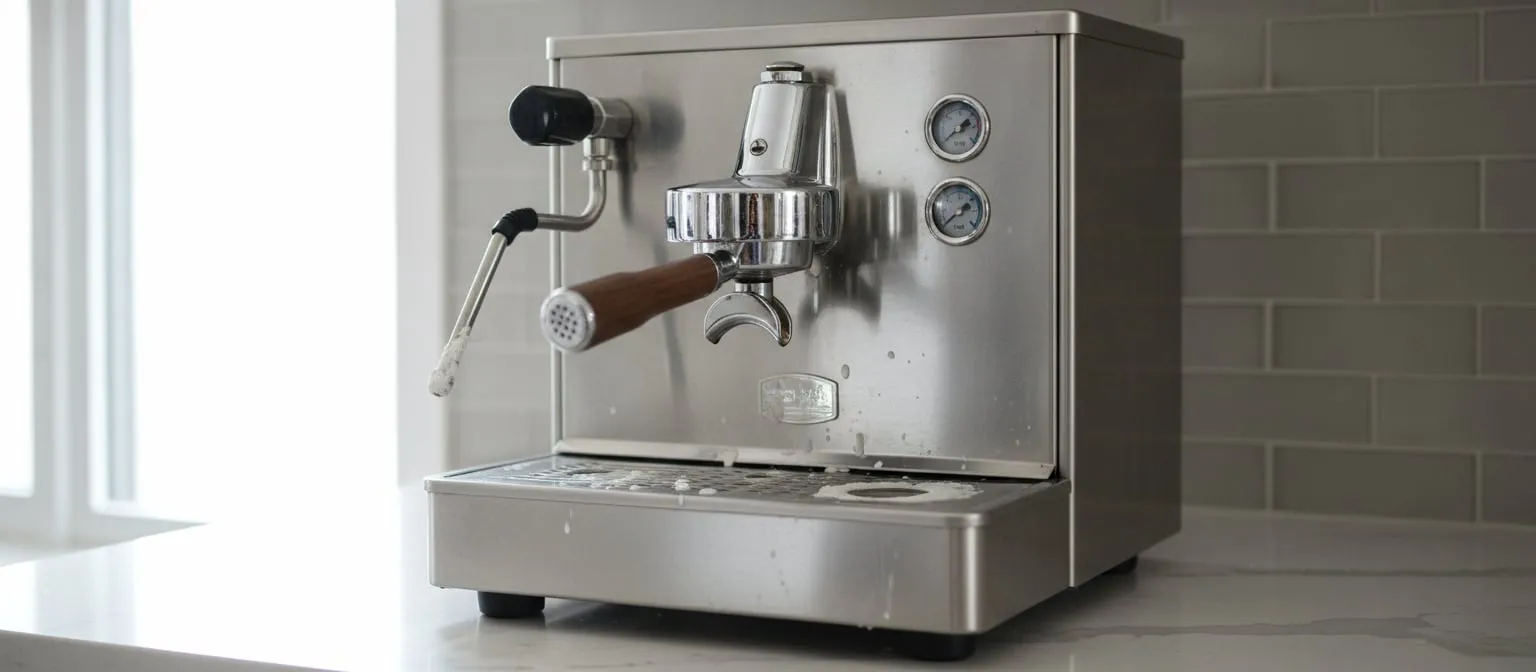
The first sign is on the drip tray. Drops of water evaporate and leave white rings and spots that a wipe does not remove. Then the steam wand: a white collar forms at the tip where steam condenses and dries between uses, and the holes in the tip start to close. Then the shower screen, seen from below with the portafilter out: the outer ring of holes goes white first, because that is where the flow is slowest.
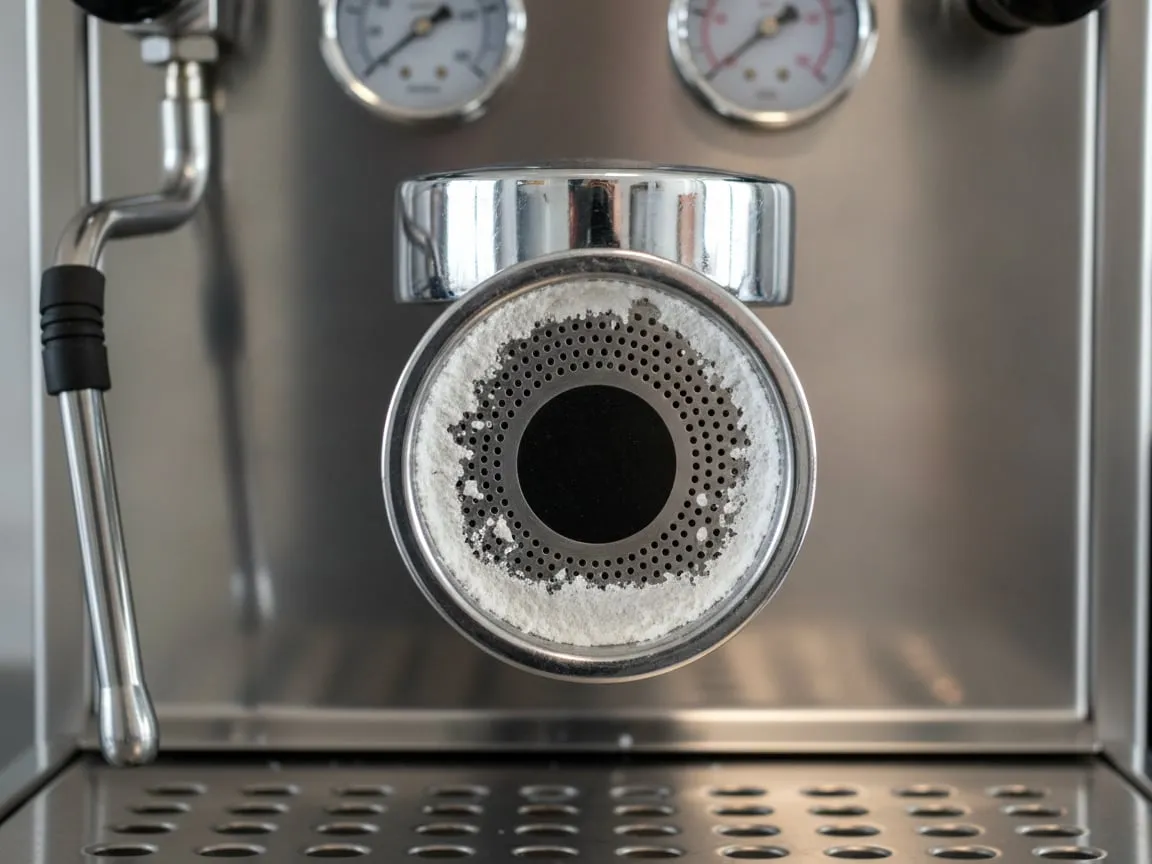
Nothing has failed yet. The water is telling you its hardness, and a strip will confirm the number. A descale now, and the water fixed afterwards, resets the clock completely. This is the stage where the fix is a filter and an hour, and it is the stage most people ignore because the coffee still tastes fine.
Stage two: the shot changes
Scale in the jet above the group and in the shower screen narrows the path, and the shot slows down with nothing changed at the grinder. The owner grinds coarser to compensate, which works for a while, then grinds coarser again. On a machine with a brew gauge the needle sits higher than it used to for the same grind. Shots channel, because the water comes through the open center of the screen and not the blocked edge. Crema goes pale.
Steam recovers more slowly between drinks, because the element in the steam boiler is wearing a jacket of scale and heats the water through it. Hot water from the tap wand is slower and the pump is louder doing it.

A descale still works here, mostly. It clears the jet and the screen and the element. What it may not clear is the flow meter paddle on a volumetric machine, which starts over-delivering as scale slows it, and the flow-control needle on a profiling group, which loses the top of its range. Those sometimes need the bench after the descale rather than instead of it.
Stage three: things that should close do not
Valve seats are the next victims. A solenoid that cannot seat on a flake of scale leaks, and the group drips between shots or the steam wand weeps water with the knob closed. A three-way valve that does not release pressure leaves the puck wet and soupy. A super-automatic shows it as a brew group that binds halfway through its stroke, and the error on the display reads like a mechanical fault. On a machine with a steam boiler level probe, the probe reads through its coat of scale and the boiler overfills, spitting water from the wand, or runs low and heats air.
At this stage a descale is a gamble. Dissolving scale upstream of a valve can free a flake that lodges in the valve. The honest sequence is a descale on the bench with the valves out, cleaned and reseated, and the self-check before that to make sure the weeping wand is not simply a knob left open.
Stage four: heat
A heavily scaled element has to run hotter to push the same heat through its insulating coat. Its life shortens. On a thermoblock machine the thermal fuse in the block opens and the machine goes cold with the lights on; on a boiler machine the element eventually cracks its sheath and trips the ground-fault outlet when it heats. Some machines show it first as temperature instability: a PID that hunts, a shot that is scalding one minute and sour the next, because the sensor and the element are both reading through scale.
Descaling does not reverse a cracked element or an opened fuse. It is a part, and it is the part that costs most on machines with the heater built into a block, because the block comes as a unit. Whether the repair is worth it depends on the machine and its age, and the repair-or-replace guide is the honest version of that conversation.
How to descale so it helps
A descale is an acid bath for the inside of the machine, and it works when the acid, the dose and the time are right. Citric acid is the gentle choice for machines with aluminum in the water path, which is most thermoblock machines and many super-automatics; sulfamic acid is faster and is what we use on brass and copper boilers at the bench. Vinegar is neither: too weak for carbonate, hard on some seals, and the smell stays in the boiler for weeks.
Mix at the dose on the packet, not stronger. A double dose does not work twice as fast; it attacks the parts the maker protected at the normal dose. Run the solution through the group and the steam wand so both circuits see it, let it sit in the boiler for the time the maker states, usually twenty to thirty minutes on a hot machine, then flush with at least two full tanks of clean water. The taste test at the end is not optional: a trace of descaler left in a steam boiler comes out in the first latte.
Machines with a descale program should be allowed to finish it. The program pauses for the tank and the tray and waits; walking away halfway leaves the machine in the middle of the cycle, which looks like a fault and is not.
Two cases where the home descale is the wrong move. A machine that stopped suddenly rather than slowed gradually, because a flake is already somewhere it should not be and acid will move it, not dissolve it. And any machine past stage three, where the valves need to come out and be cleaned by hand, which is bench work in the order described below.
What each stage costs you
A machine on raw Southern California tap reaches stage two in a year and stage four somewhere between three and five years, depending on how much it is used and how often it is descaled. The same machine on water inside the band, from a cartridge, a pitcher or a treated supply, is still at stage one at ten years and comes to us for gaskets. Nothing else in the life of the machine, not the brand, not the price, not how carefully it is cleaned, moves the number as far as the water does.
The order of repair
Fix the water before the machine, or alongside it, never after. A new element on raw water is a loan against the next element. A rebuilt brew group on fifteen-grain water stiffens again in eighteen months. For a tank machine the fix is on the home water page. For a plumbed machine it is a cartridge on the line, sized and dated, and for a house where every tap scales it is treatment at the point of entry, which starts with a test at the address. Then the descale, or the bench, and the machine stays fixed.
If you are at stage one, a strip and a filter this week is the whole repair. If you are at stage three or four, tell us what the machine is doing and whether the kettle scales too; it changes what we bring.