Water for a Home Espresso Machine
Tank cartridge, pitcher, bottled or the tap: what to put in a home espresso machine on Southern California water, what each costs per month, and two to avoid.
A home espresso machine drinks a liter or two a day out of a tank you fill by hand, and that is good news: you choose the water, every time. The bad news is that the default choice, the kitchen tap in LA County, is two to four times harder than the machine was designed for, and the machine will tell you so in about a year, through a slow shot, a weak steam wand and a descale light that will not go out.
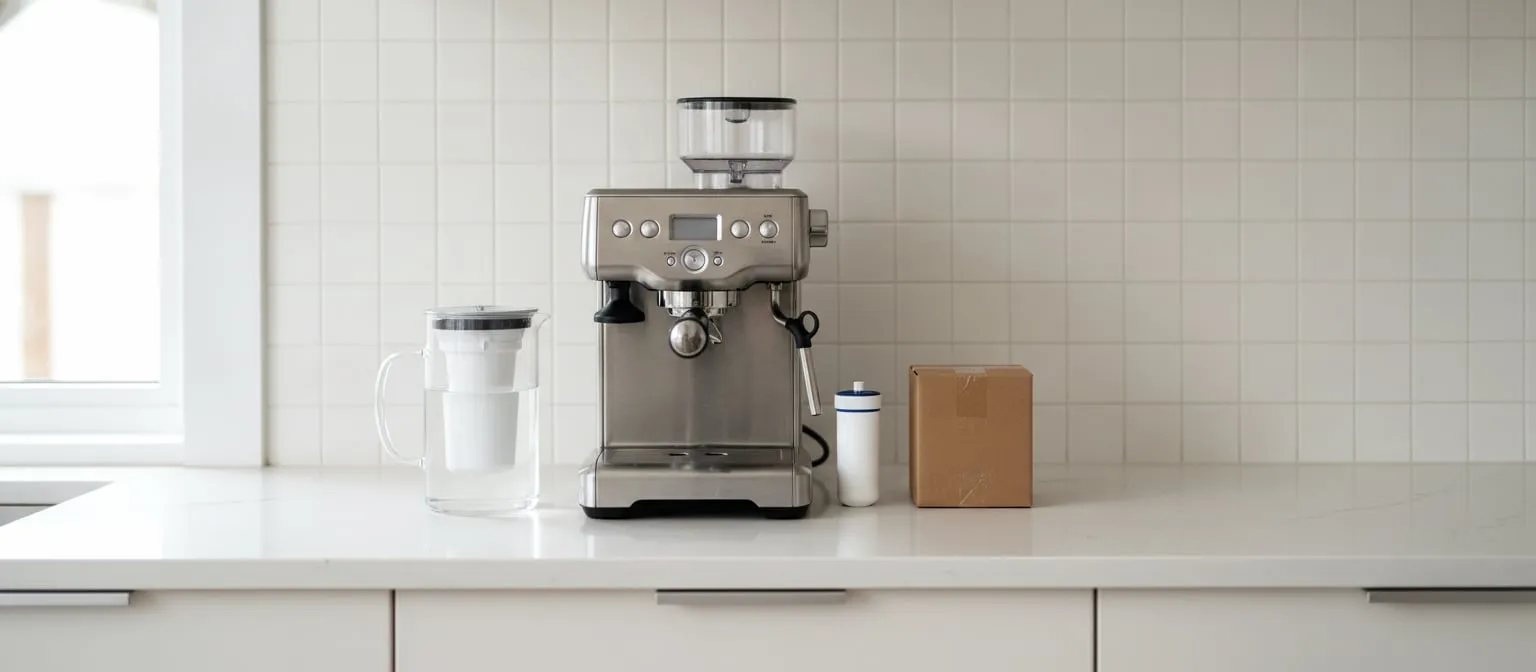
There are five ways to fill the tank. Two are good, one is fine with a caveat, and two we see in the machines that reach the bench early.
The tap, untreated
Hardness between seven and sixteen grains across Los Angeles, more in Orange County and the Inland Empire, with chloramine on top. In a thermoblock machine, which is most Brevilles and most entry-level machines, scale coats the heating passage within months and the passage cannot be opened to clean. In a boiler machine the element coats and the jet narrows. The descale cycle slows it down; it does not stop it. A machine on raw tap water here needs descaling every six to eight weeks to stay out of trouble, and almost nobody does that.
Untreated tap is the water we find in most machines that come to us under three years old with a heating fault.
The in-tank cartridge
Most makers sell a small resin cartridge that sits in a holder in the tank. Breville’s drops into the tank floor; the larger Brevilles use a clip-in version with a date dial; Jura, De’Longhi, Saeco and Philips each have their own. They are all ion-exchange resin: calcium out, sodium or hydrogen in, before the water reaches the pump. Pick the one marked for your model, because the holders differ, and the filter guide lists them by brand.
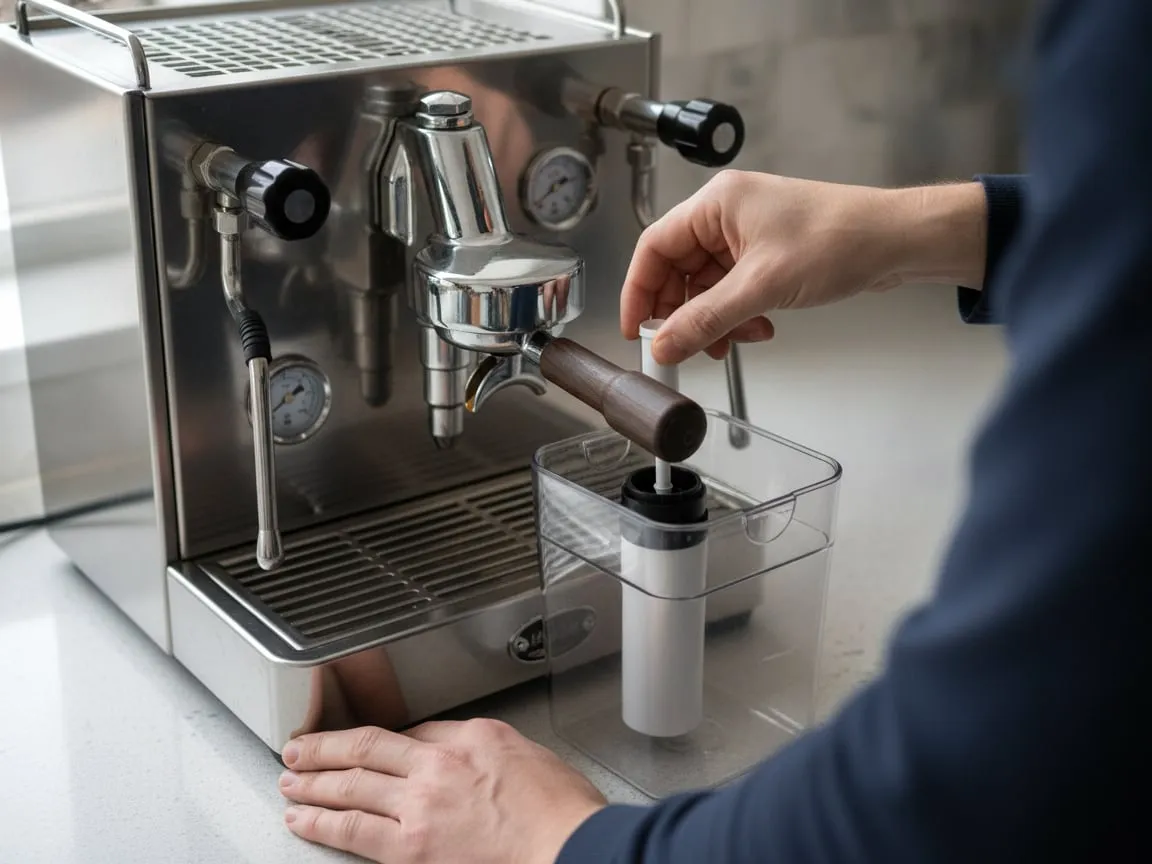
What the box does not say is that the rated life assumes moderately hard water. A cartridge sized for three months at eight grains is spent in six weeks at fifteen, and after that the machine is on raw water again while the dial still says it is fine. On the softer half of our area the cartridge alone gets the water into range. On the harder half it helps, and it is not enough on its own; the pitcher below in front of it is the combination that works.
One thing to do regardless: set the machine’s hardness setting from the strip in the box. That number drives the descale reminder, and a machine left on the factory default for soft water will ask for a descale long after it needed one.
The pitcher
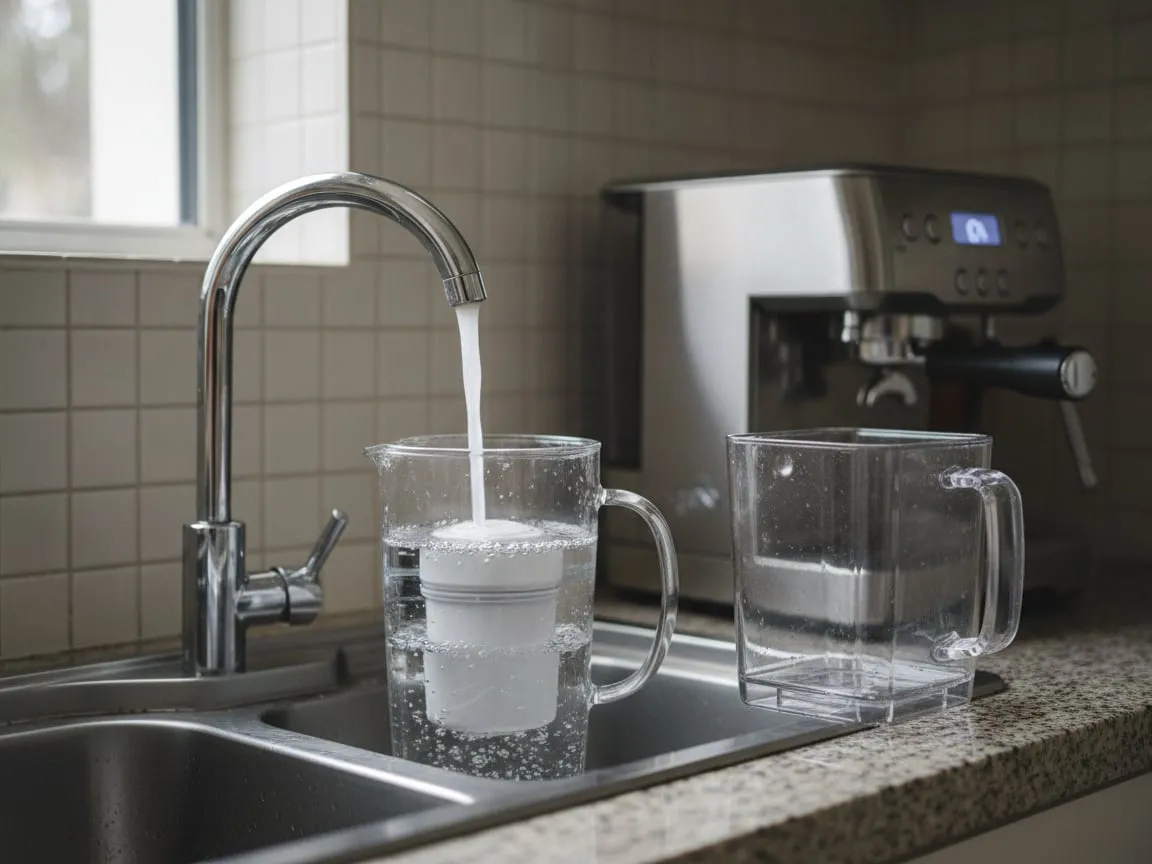
A pitcher filter designed for coffee has a softening dial, set from a test strip, and brings the water into the band before it reaches the tank. Filled from the tap, it does the heavy work; the in-tank cartridge then has little left to do and lasts its full life. This is the setup we suggest for a Rocket, a Lelit, a Profitec or a Breville Dual Boiler on hard water: pitcher first, cartridge second, strip once a month.
The ordinary kitchen pitcher is a different device. It is carbon, sometimes with a little resin, and it mostly takes out chlorine and taste. The cup improves, the hardness barely moves, and the machine scales as before. If the pitcher does not have a hardness setting, it is not softening.
Bottled water
Spring water is whatever came out of that spring. Some brands are softer than our tap, some are harder, and the label rarely says. Test the brand with a strip before you buy a case, and test again when the source changes, which it does. Purified bottled water is almost always reverse osmosis, which brings us to the two options we advise against.
The two to avoid
Distilled and straight reverse osmosis water. Both are nearly empty, which sounds like no scale and is, and also like no cup. The shot tastes thin and sour, the water pulls a little copper and zinc out of the boiler fittings over time, and several machines with a capacitive level sensor cannot see the water at all and ask for a refill from a full tank. If RO is what the house has, blend it with tap water, roughly one part tap to three parts RO, or run it through a remineralizing cartridge. Blended, it is good water. Alone, it is a slow problem.
Water from a household softener that nobody set up. A softener delivers whatever its valve was programmed for, and one programmed for very hard water and left alone can hand the machine zero hardness and a lot of sodium. The cup tastes faintly salty and the boiler gets the thin-water treatment above. The softener needs a service visit; the machine does not need anything.
What each option costs you, per month
In words rather than figures, because the figures move and the ratios do not.
The tap costs nothing per month and one descale every six to eight weeks, which is an hour and a bottle of descaler each time, plus the element or the thermoblock when it goes. Over three years it is the most expensive option on this page by a wide margin.
An in-tank cartridge changed when it is actually spent, every six weeks on hard water, costs about what a bag of good beans costs each month. Changed every three months as the box says, it costs less and protects less.
A coffee pitcher costs more up front and its cartridges about the same per month as the in-tank kind. Pitcher and cartridge together, which is the setup for the harder half of our area, comes to roughly two bags of beans a month and takes the descale interval from every two months to once or twice a year.
Bottled water for a liter a day runs to several cases a month, costs more than pitcher and cartridge combined, and still needs the strip test to know whether it is any good.
Treating the house is the only option with a real installation cost, and the only one whose running cost per month is lower than any of the above once it is in, because the cartridge discipline goes away and so does the descale schedule.
When the machine is the wrong place to fix it
If the kettle scales, the shower door is white and the dishwasher leaves spots, the espresso machine is the first appliance to complain and not the only one suffering. A tank cartridge protects one machine. A softener at the point of entry, with a carbon stage ahead of it, protects the water heater, the dishwasher, the shower and the machine together, and the machine then runs on the water it was designed for with no cartridge discipline at all. That is a water treatment job, the test at the house comes first, and for drinking water at the kitchen tap an under-sink RO unit with a remineralization stage sits beside it.
A monthly habit
Test the tank water with a strip once a month for the first three months. If it reads inside the band, the setup works and you have learned the real change interval for your water. If it drifts up, the cartridge is spent earlier than the box says, and the fix is a date on the calendar rather than a new machine. A machine that gets water inside the band from day one is the one that comes to us at ten years old for a gasket, not at three for an element. If it is already past that point, the hard-water page tells you what a descale will and will not recover, and the request form gets the house tested.