The right water filter for your machine
Southern California tap water is hard. Depending on your neighborhood, Los Angeles water runs roughly 7 to 16 grains per gallon, and most of Orange County, the Inland Empire and San Diego draw on the same imported supply. Descaling removes the buildup, but without filtered water it starts coming back from the very first shot.
The fix is cheap: the right filter for the machine, changed on time. Below is which one goes where, and the two cases where the machine is not the problem.
Breville Barista Express,
Barista Pro, Infuser, Bambino
These machines take Breville's own in-tank resin filter. It drops into the holder in the water tank, cuts hardness and chlorine, and is good for about two months on our water. Buy the one marked for your model; the holders differ.
Then set the machine's water hardness to match your tap: the test strip comes in the box. That is what makes the machine ask for a descale at the right time instead of too late.
Breville Oracle, Oracle Touch,
Barista Touch, Dual Boiler
The larger Brevilles use the clip-in tank filter with a date dial on top. Turn the dial to the month you installed it and change it every three months. On the Dual Boiler the filter matters more than on any other Breville: the steam boiler scales first and is the most expensive part to open.
Super-automatics
(Jura, De'Longhi, Philips, Saeco, Miele)
Use the maker's own in-tank cartridge and switch the filter setting on in the machine menu, so the machine counts litres and asks for the change itself. Do not skip it: a super-automatic puts every drop through a narrow brew group, and on unfiltered SoCal water the group stiffens within a year. If the machine keeps asking for water with a full tank, read the self-check before buying anything: a float stuck in scale is the usual cause, and it is the same scale. Choosing a machine rather than fixing one? Read what fifteen super-automatics taught us this fall before you spend the money. Buying a first machine instead? The beginner guide starts with the same water advice.
Filling the tank by hand?
A coffee pitcher
A pitcher filter designed for coffee, with an adjustable softening dial set from a test strip, is the simplest upgrade for any tank machine. The cartridge works harder on our water than the box suggests, so change it on the early side.
Avoid pitchers and jugs that strip water down to almost nothing, and avoid distilled water. Empty water tastes flat in the cup, can corrode the inside of the boiler, and several machines cannot read the level of it in the tank and sit there asking for water.
Machines connected
to a water line
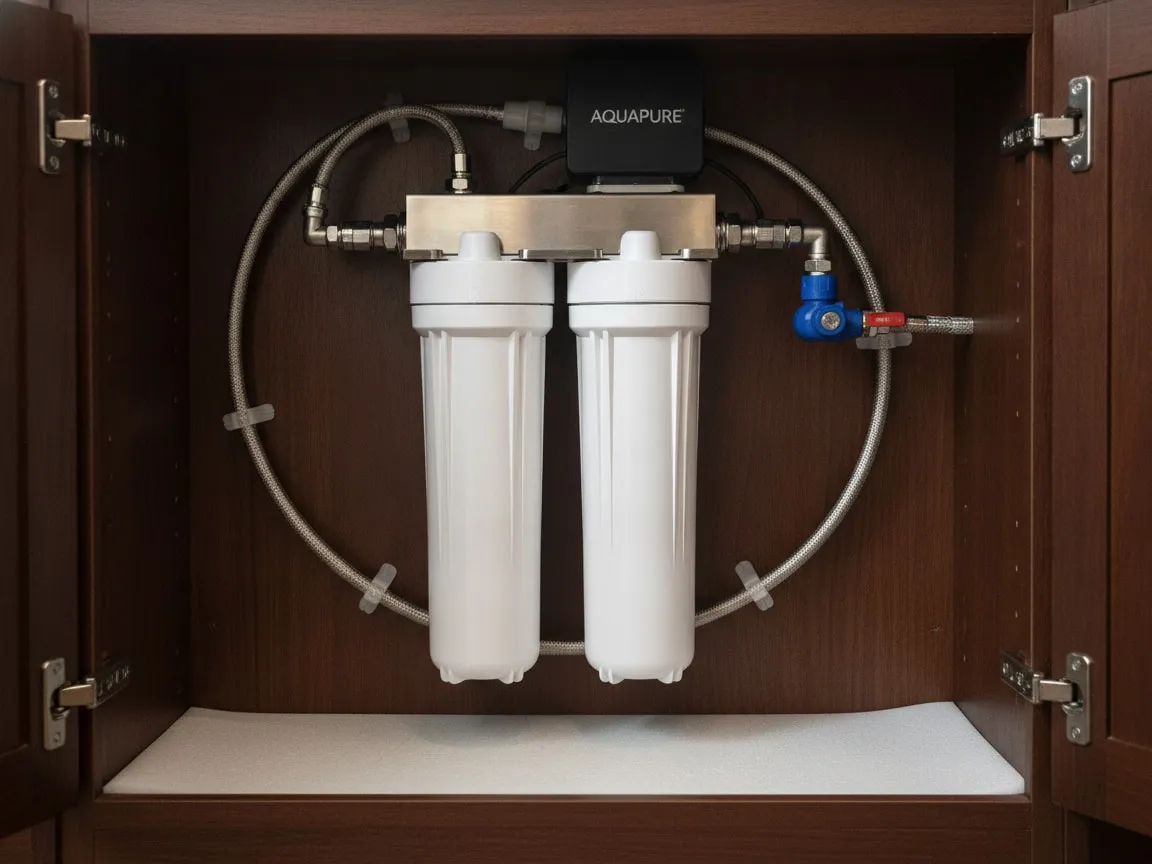
Commercial machines and plumbed-in home machines (Rocket R series, Profitec Pro 600 and up, Lelit Bianca, ECM, La Marzocco Linea Mini and similar) use an inline filter: a head on the water line and a replaceable cartridge in it.
- A softening cartridge with an adjustable bypass is the solid choice for most machines: it takes the hardness down to where the machine wants it and leaves enough mineral for the cup.
- A remineralizing cartridge softens and adds magnesium back for extraction. Our pick for high-end home machines and for bars running lighter roasts.
The cartridge twists out and in by hand once or twice a year; the install date goes on the head. We size, install and track these as part of our water treatment service, and on a maintenance contract the change rides the same visit as the machine.
When the machine
is not the problem
If the kettle furs up, the glass shower door is white and the dishwasher leaves spots, the espresso machine is just the first thing to complain. A tank filter protects one machine; a softener at the point of entry protects every tap, the water heater and the machine at once. That is a different job, and it is one we now do: the water is tested at your address first, the system is proposed in writing, and our water team installs it. For drinking water alone, an under-sink reverse osmosis unit is the right tool, with a remineralization stage if the espresso machine is to run on it.
Request the water test, or call and ask for it. Nothing is quoted before the test.
Why
we care
Most machines that come to our bench did not fail from age, they failed from scale. Scale insulates the heater, narrows the water path and keeps valves from sealing. Machines with thermoblock heaters, which includes most Breville models, cannot be cleaned mechanically inside: once scale builds up, it is a descale or a new part. A filter that costs less than one descale is the cheapest repair you will never need.
If we have repaired your machine and filtered water was a condition of your warranty, using the right filter keeps that warranty in force.
Questions about
your machine? Call us.
Not sure which filter fits, or whether the scale has already done damage? Call, or tell us the brand and model and we'll point you the right way.
Emergency · 24/7
25 cities · same-day