Espresso machine parts diagram: four designs
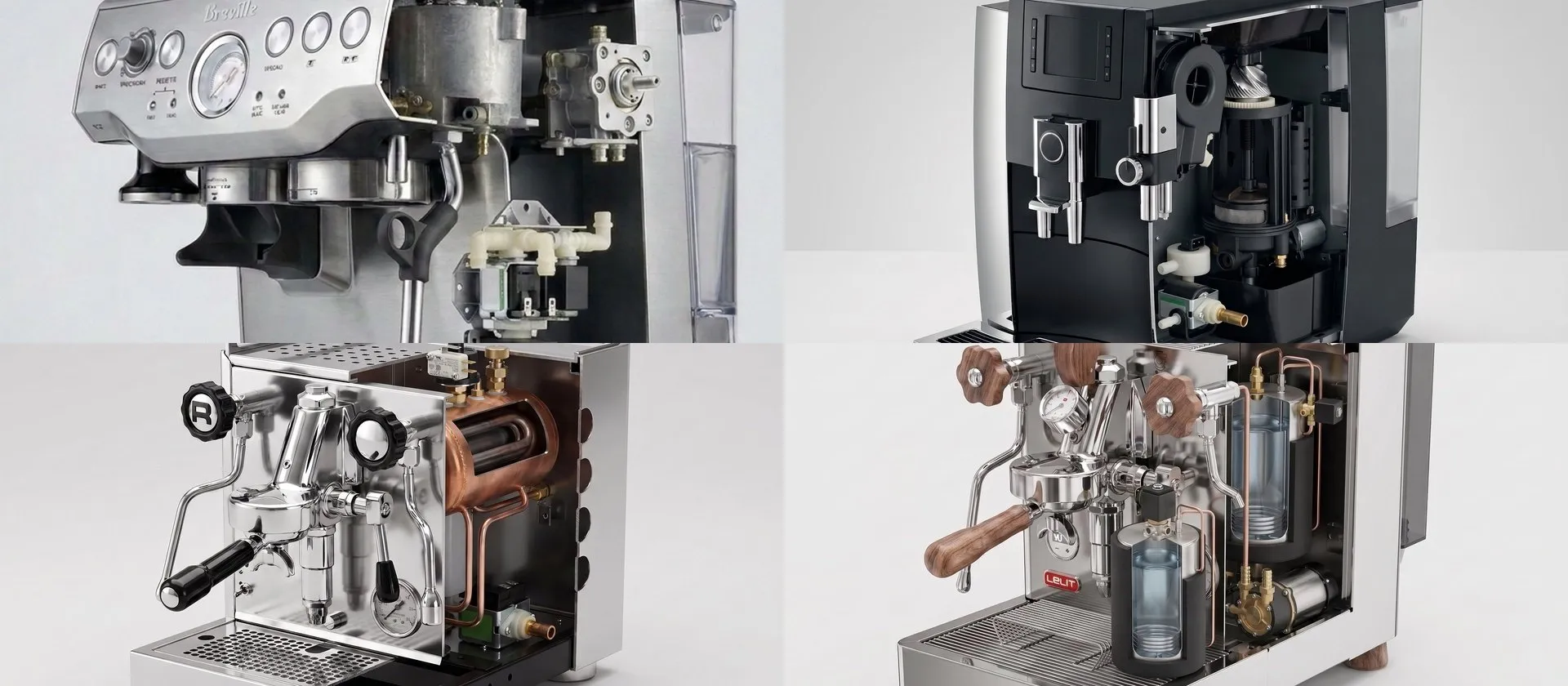
The parts of an espresso machine, named and placed, across the four designs: thermocoil, super-automatic, heat exchanger and dual boiler, with five cutaways.
Every espresso machine on the market, from a 300 dollar countertop unit to a three-group bar machine, is one of four designs, and the design is decided by one part: the heater. Everything you feel from the outside follows from it. How long the warm-up takes, whether you flush before a shot, whether you can steam milk while the coffee runs, where the scale collects, and what we charge to service it. This page names the parts that every machine shares, then walks through the four designs with a cutaway of each, so you can find your own machine and open the interactive drawing that belongs to it.
The parts, by name
Start at the water and move forward. The reservoir is a plastic tank with a float or two contacts that tell the machine when it is empty; plumbed machines replace it with a supply line and a filter. The pump is either a vibration pump, a small brass solenoid pump that buzzes at 60 Hz and lives in nearly every countertop machine, or a rotary pump on a separate motor, which is quiet, can run from a water line, and is what you find in bar machines and the better home ones.
The heater is the part with four answers, and the rest of this page is about them. Past it sits the group head, the chromed brass block where the portafilter locks in; inside it are the dispersion screen that spreads the water over the coffee and the group gasket that seals the basket, the two parts that wear on every machine in about the same way. Behind or beside the group is the three-way solenoid, the valve that vents the pressure left in the puck into the drip tray when the shot ends; without it the puck sprays when you unlock. Somewhere on the brew path is an expansion valve or over-pressure valve that caps the pressure, usually around 9 bar at the puck.
On the steam side, a machine that stores hot water has a steam boiler with a pressure switch or a PID holding it at a set point, a vacuum breaker that lets air out as it heats and air in as it cools, a safety valve set a little above working pressure, and a level probe that calls the pump to refill it. The steam valve and wand hang off that boiler. A machine with no boiler makes steam in the same block that makes coffee, one job at a time. Finally the gauges: one for the steam boiler on most machines, a second for brew pressure on the better ones, and a display in place of either on a super-automatic.
Design 1 — thermocoil, no stored water
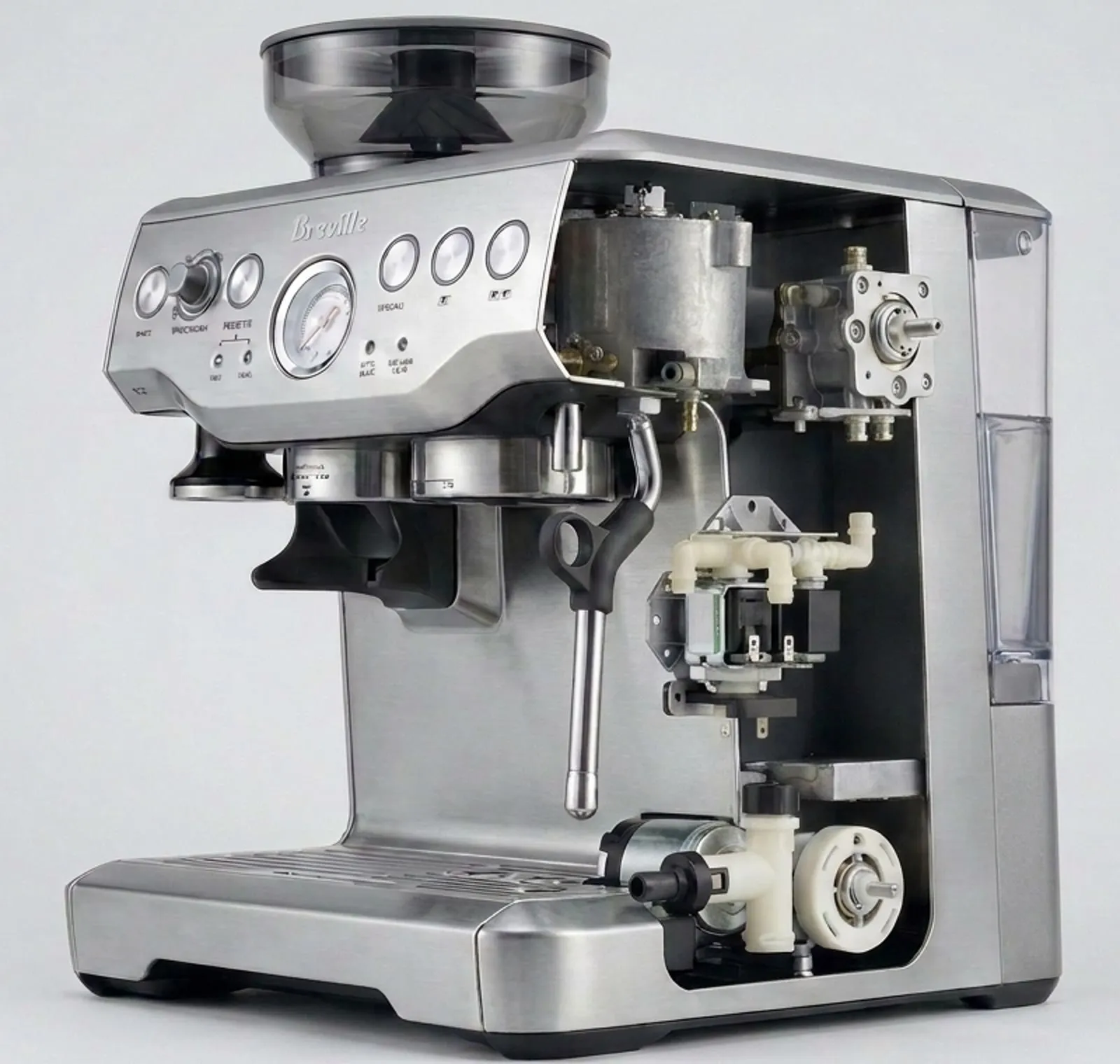
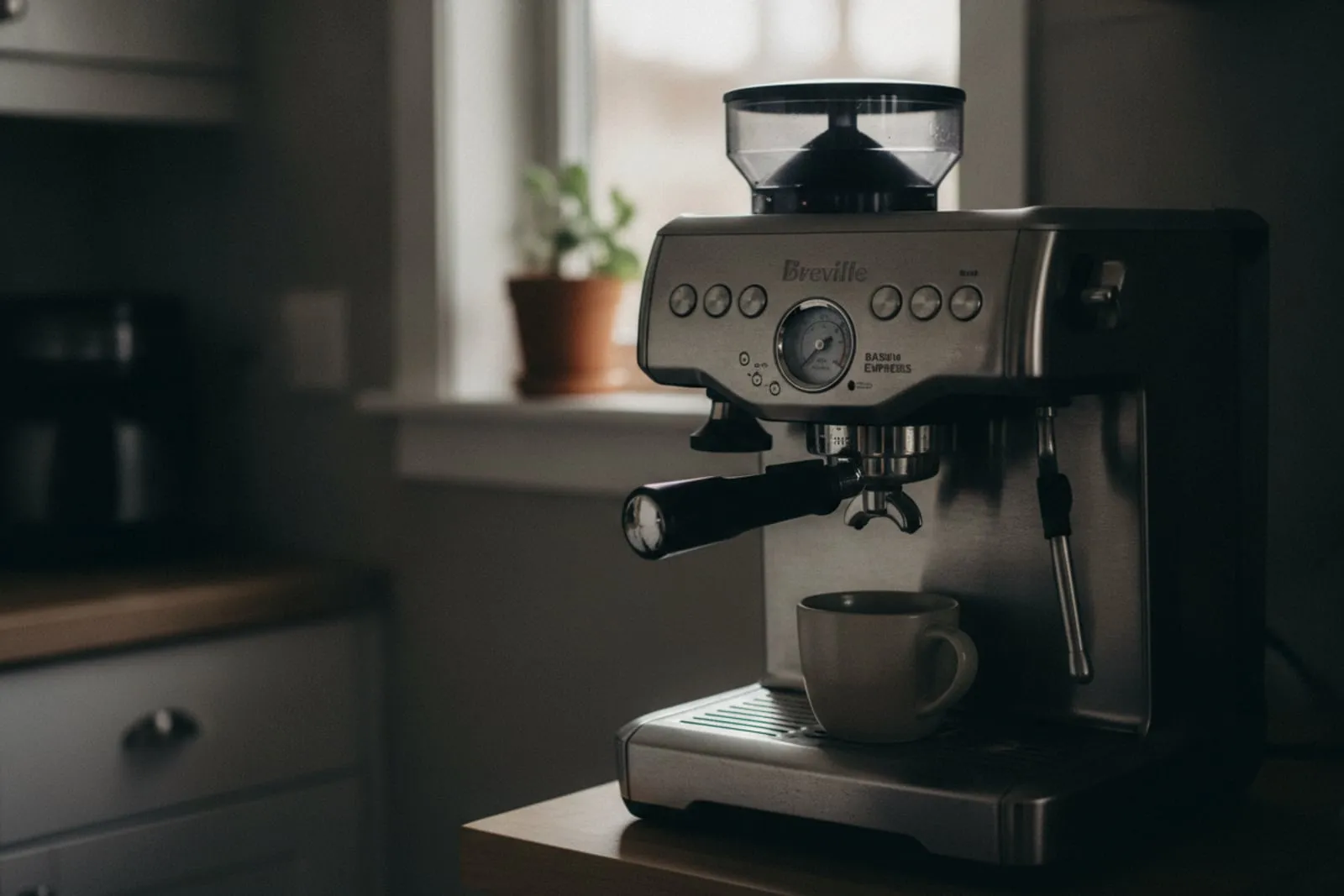
The Breville Barista Express and its relatives, the Bambino, the Infuser and the Barista Pro, along with most DeLonghi and Gaggia countertop machines, heat water as it passes. A stainless channel cast into an aluminum block, wrapped in a 1,600 W element, brings the water to temperature in the two seconds it spends inside. There is no boiler, so the machine is ready in about three seconds from switch-on and there is no cooling flush. The same block makes steam, so milk and coffee take turns, and the steam is thin next to a boiler machine’s.
Scale lands in the one place water always passes, the channel itself, and a thermocoil that has narrowed shows as a slow shot with a high gauge needle at a grind that worked before. A descaler through the tank is the right tool here, because the channel is the only path there is. Our Barista Express cutaway opens it up, part by part, with photographs of neglected parts from our own bench, and the service is the $249 Breville tier.
Design 2 — super-automatic, with a brew unit
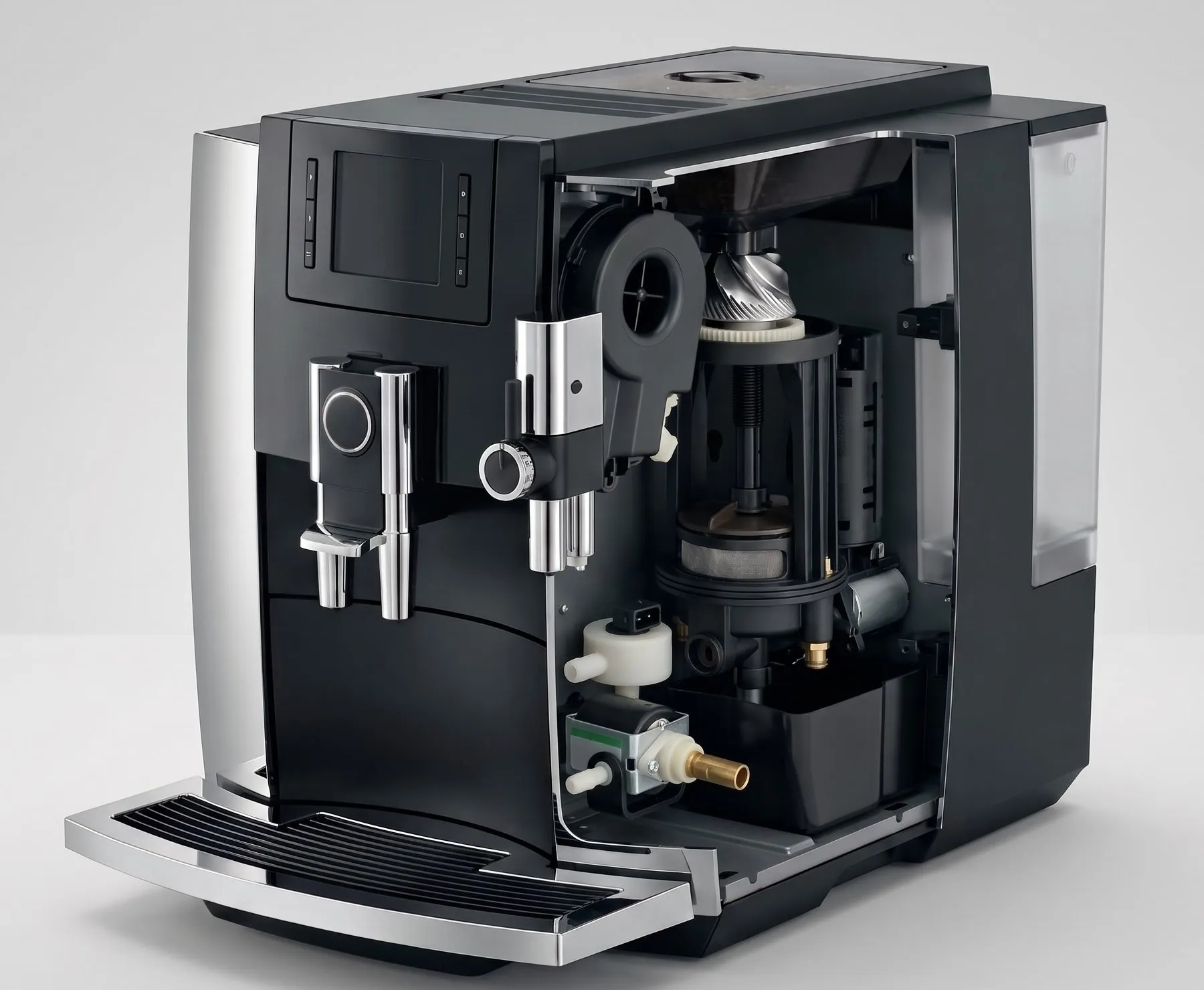
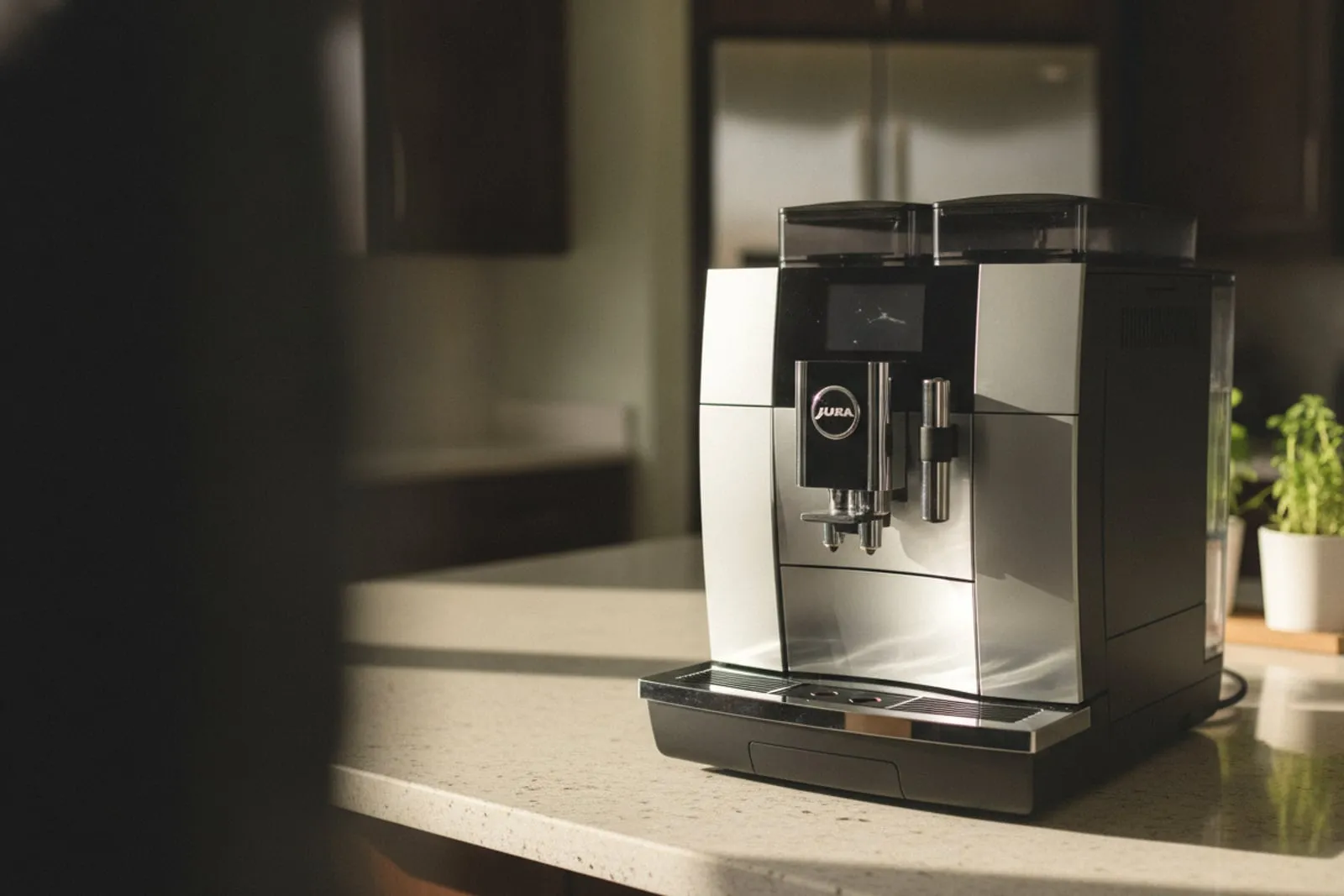
Jura, DeLonghi Magnifica, Philips and Saeco, Miele: a grinder, a thermoblock heater of the same kind as above, and a brew unit, a plastic piston assembly on a gear motor that doses the grounds, presses them, receives the water and ejects the puck into a bin. Nothing on it is adjusted by you; the machine measures the flow with a flow meter and counts shots for its own cleaning cycles. It is the only design with moving parts in the coffee path, and the brew unit is where the wear goes: seals, the drainage valve, the gear train.
Scale here produces error messages before it produces bad coffee, because the thermoblock sits behind sensors that the firmware reads. The Jura E8 cutaway shows the brew unit’s cycle step by step, and the brew unit error guide covers what the messages mean. Service runs on the $329 Jura compact tier for the E and ENA lines.
Design 3 — heat exchanger, one boiler for both jobs
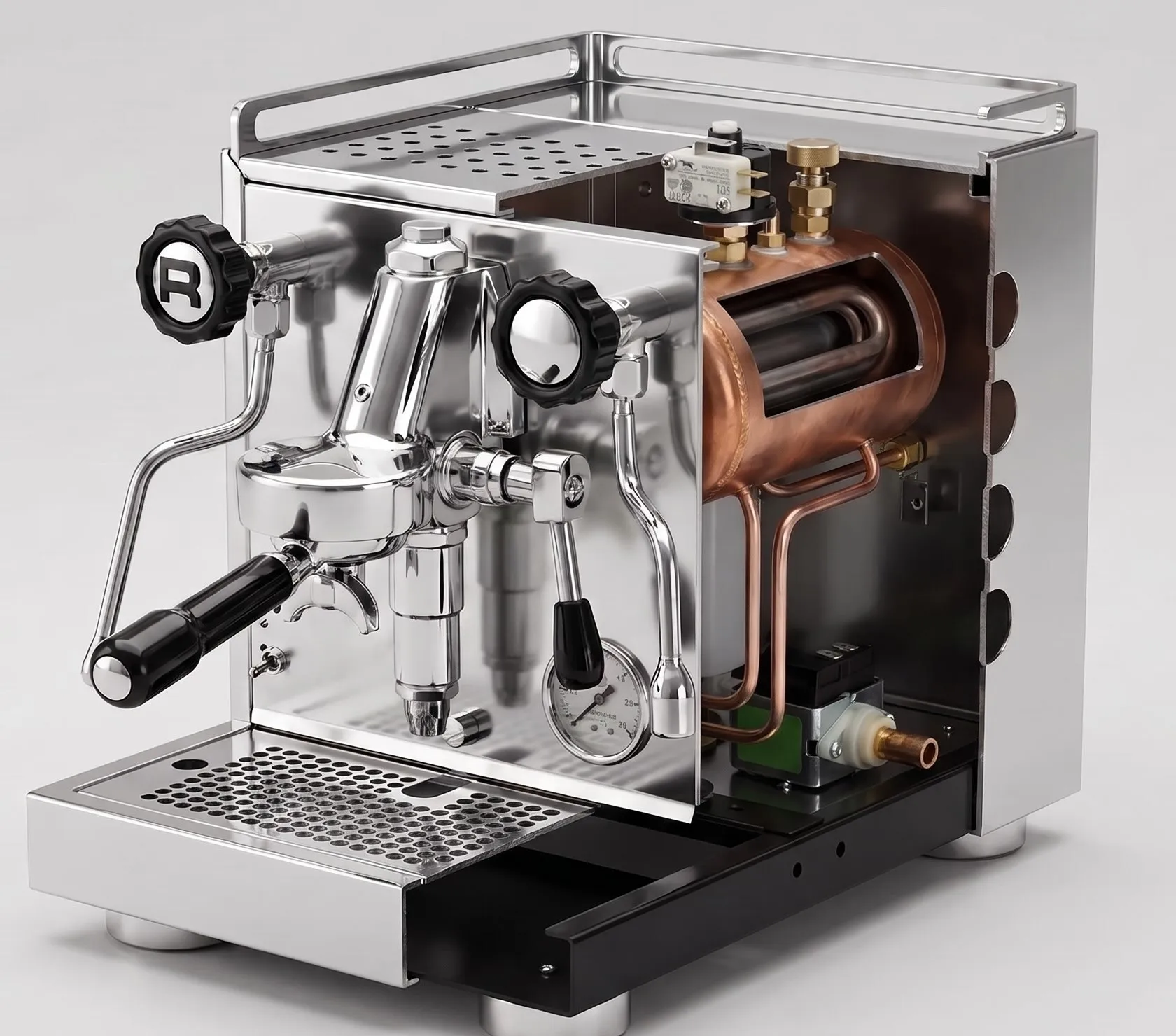
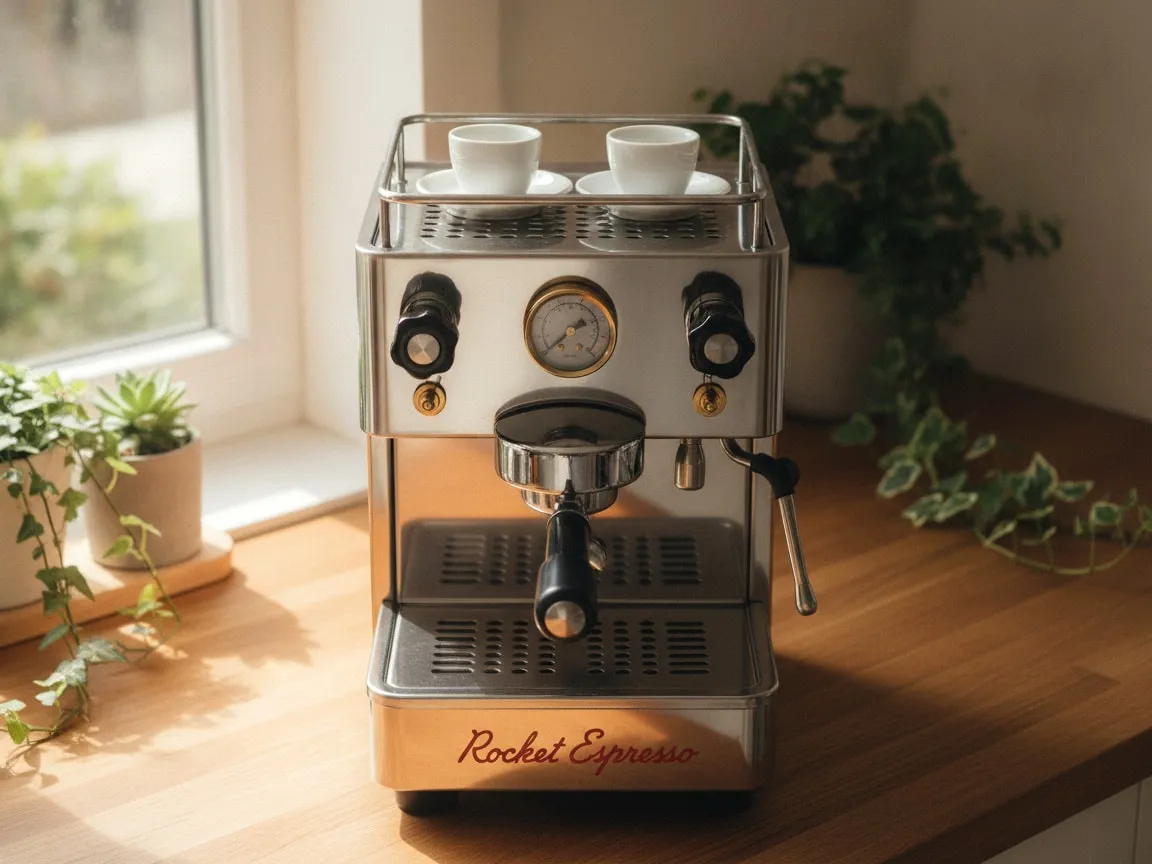
Rocket Appartamento and Giotto, Profitec Pro 500, ECM Mechanika, Bezzera BZ10, Nuova Simonelli Oscar, and nearly every two-group bar machine built before 2010: a single copper boiler held at about 1 bar and 120 °C makes steam from its top, and the brew water runs through a tube that passes through that boiler, picking up heat without touching the boiler water. A thermosiphon loop between the tube and the E61 group keeps the brass hot between shots. Warm-up is about 20 minutes, and the water that sat in the tube is too hot, so you flush for a few seconds before every shot.
This is the design that scales in the most places at once: the boiler, the tube, the group jet, and the vacuum breaker, all from one 1.8 litre volume of water that boils all day. It is also the design the makers tell you not to descale at home, and the Appartamento cutaway shows why, with the boiler and the tube drawn open. The service is the $429 E61 tier plus its descale line.
Design 4 — dual boiler, and its saturated cousin
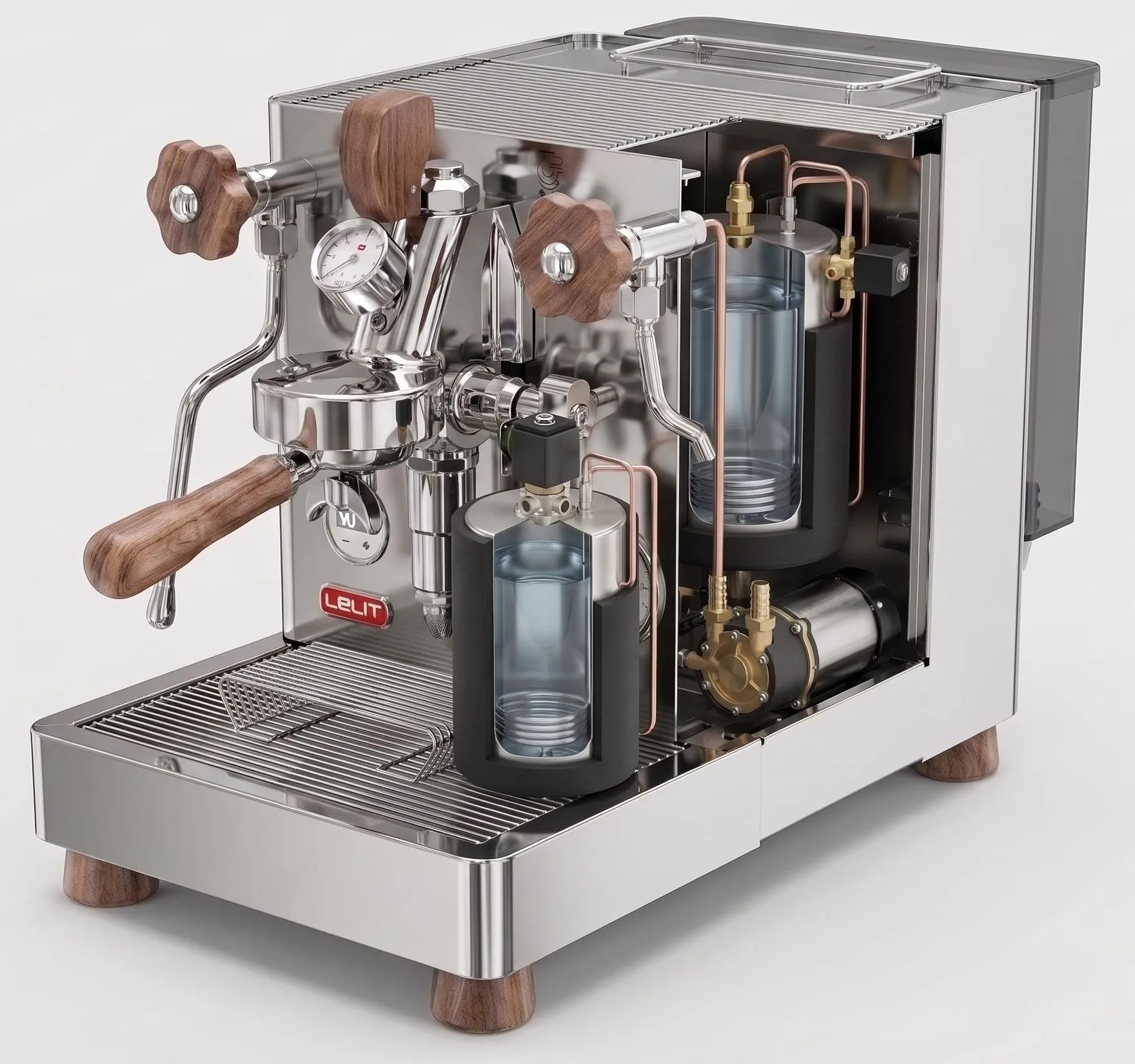
Lelit Bianca, ECM Synchronika, Profitec Pro 700, Rocket R58, Breville Dual Boiler: two boilers, one full of water at brewing temperature on a PID, one two-thirds full at steam temperature, each with its own element. The brew boiler feeds only the group and never boils, which is why the temperature holds within a degree and why you can steam a jug while a shot runs. There is no flush. The quiet cost is that scale in the brew boiler is invisible: the PID keeps reporting a good temperature from a probe bathed in water, while a jacketed element runs hotter and the shot drifts.
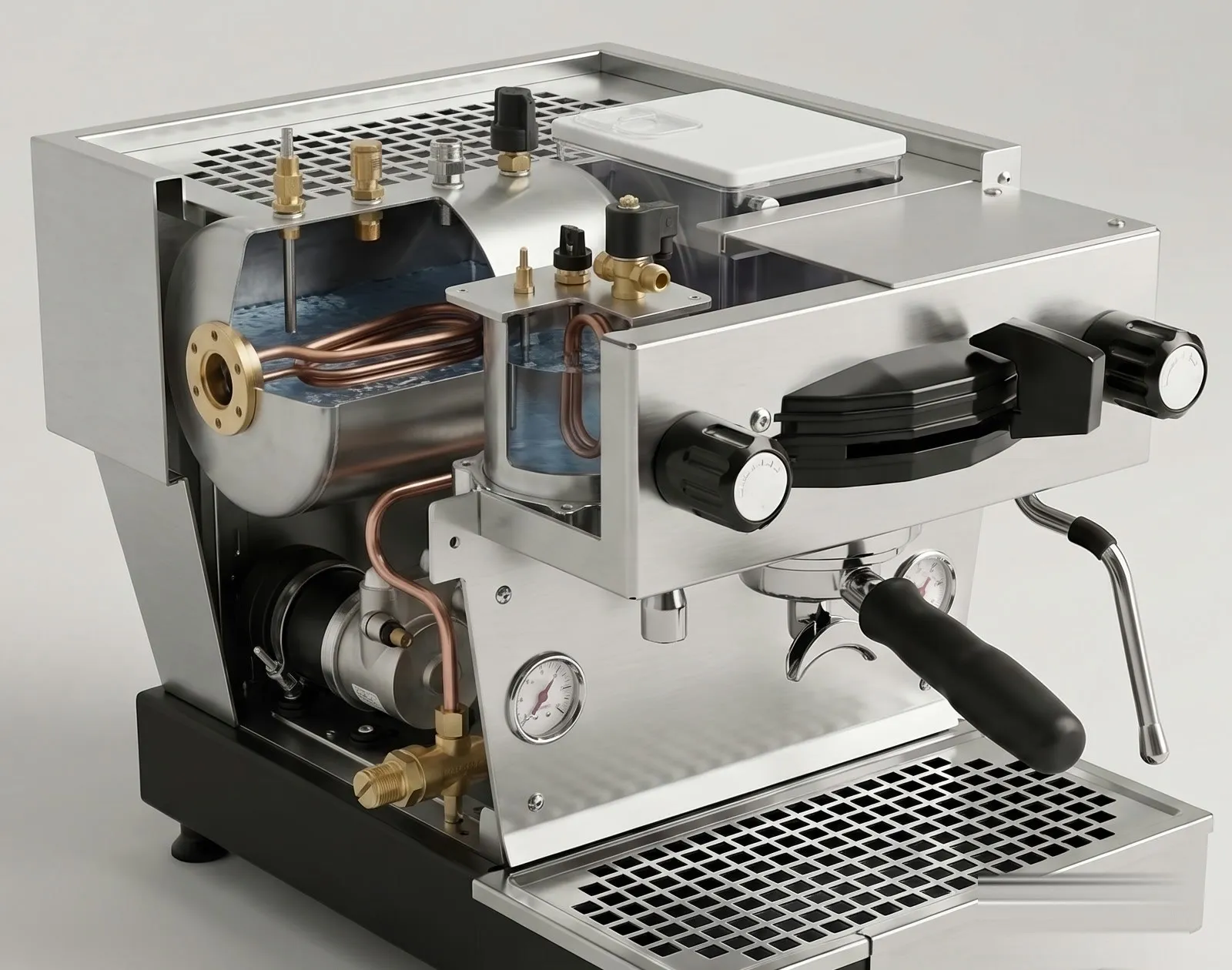
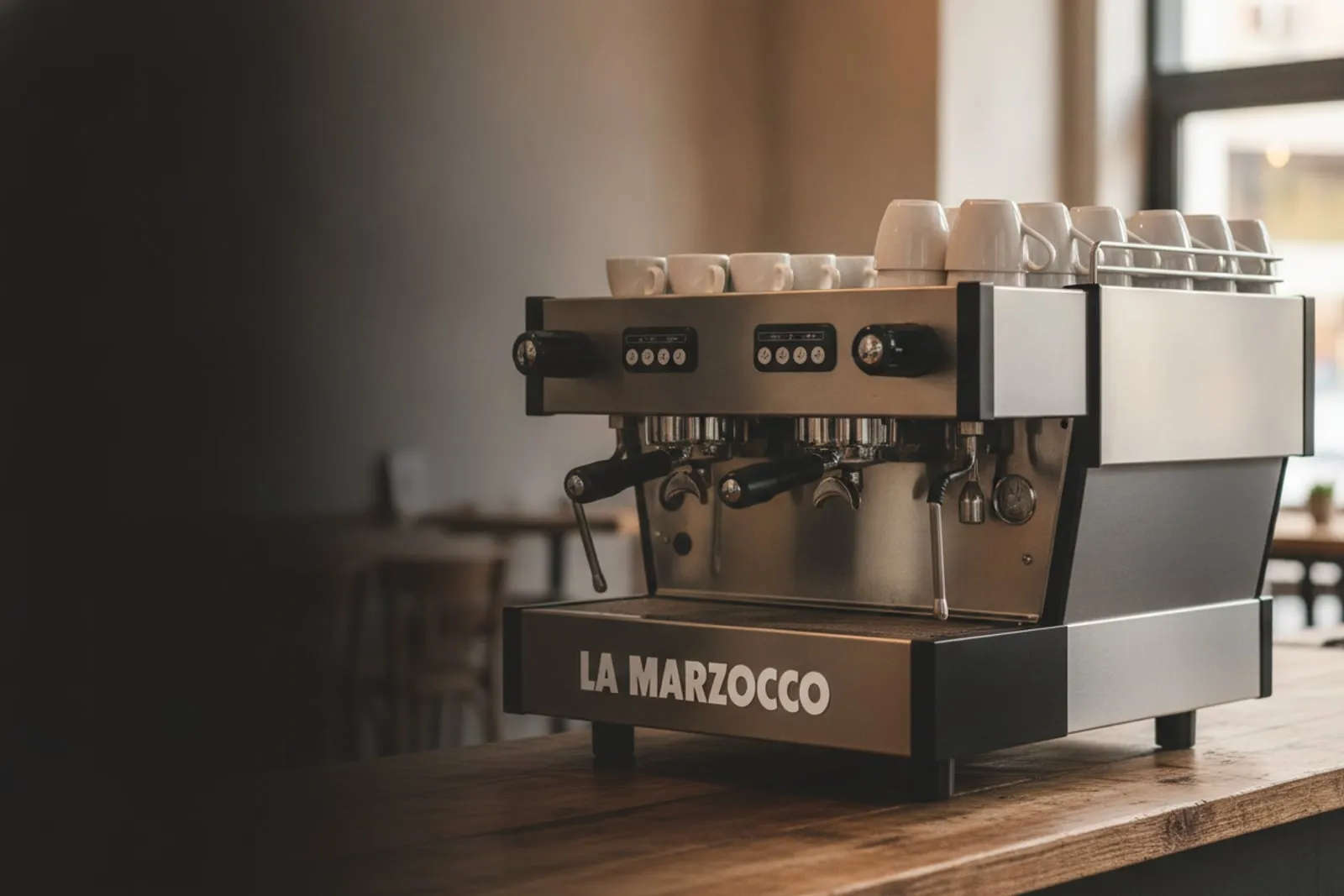
La Marzocco’s Linea Mini and GS3, and every group on a Linea PB or a GB5, are the same two-boiler idea with the brew boiler built onto the group itself: a saturated or integrated group, 0.17 litres of water heated where it is used, with an expansion valve to relieve it as it warms. The Bianca cutaway and the Linea Mini cutaway are drawn side by side on purpose, so the difference between a brew boiler in the chassis and a brew boiler on the group is visible. The Bianca runs on the $429 E61 tier; the Mini on the $449 home-commercial visit, on site, because it is heavy and often plumbed.
The four side by side
| Thermocoil | Super-automatic | Heat exchanger | Dual boiler | |
|---|---|---|---|---|
| Heater | block, heats on the way through | thermoblock behind a brew unit | one boiler, tube through it | two boilers, or boiler on the group |
| Ready from cold | 3 seconds | 1 to 2 minutes | about 20 minutes | 20 to 25 minutes |
| Flush before a shot | no | no | yes, every shot | no |
| Steam while brewing | no | no | yes | yes |
| Scale shows up as | slow shot, high needle | an error message | hiss, drips, weak steam | nothing, then everything |
| Descale at home | yes, through the tank | yes, its own program | no | no |
| Our service tier | $249 | $329 | $429 | $429 to $449 |
Which one is on your counter
You can tell from the front. A bean hopper and buttons with no portafilter is a super-automatic. A portafilter and a machine that is ready before you have found a cup is a thermocoil. One gauge on the front, a lever on the group, and a habit of running water before each shot is a heat exchanger. Two gauges, or a display showing a brew temperature you can set to the degree, is a dual boiler. If the machine is stainless, has a paddle, and weighs more than a child, it is the saturated-group kind.
Why the design decides the bill
Our prices sit on the design, not the badge, because the design decides the hours. A thermocoil comes apart in an evening and goes back together the same night. A heat exchanger has a boiler to drain, a tube to clear and a group to strip, and the yearly descale is a bench job. A dual boiler has two of everything to drain and two probes to check. A saturated group is plumbed, heavy and on your counter, so we come to it. The descaling guide explains why the home remedy works on the first two designs and moves the fault on the other two, and the repair page lists what a bench visit includes. Pickup runs from Los Angeles across six counties; the full price table is on the pricing page.
$145 diagnostic for countertop machines we collect and return; $250 on-site diagnostic for plumbed and commercial machines. Either diagnostic is credited in full toward the repair when you approve the estimate.